It was considered by all educated Catholics to be established science and compatible with Scripture.
Jayne, did those scholars have a diagram of how the firmament which divides the waters from the waters works with a ball earth model?
It seems to be a
solid divider:
Rāqīaʿ means that which is firmly hammered, stamped (a word of the same root in Phoenecian means "tin dish"!). The meaning of the verb rqʿ concerns the hammering of the vault of heaven into firmness (Isa. 42.5; Ps.136.6). The Vulgate translates rāqīaʿ with firmamentum, and that remains the best rendering.From the Douay R:
"And God said: Let there be a firmament made amidst the waters: and let it divide the waters from the waters.
[Genesis 1:6]
2
"And God made a firmament, and divided the waters that were under the firmament, from those that were above the firmament, and it was so.
[Genesis 1:7]
3
"And God called the firmament, Heaven; and the evening and morning were the second day.
[Genesis 1:8]
4
"And God said: Let there be lights made in the firmament of heaven, to divide the day and the night, and let them be for signs, and for seasons, and for days and years:
[Genesis 1:14]
5
"To shine in the firmament of heaven, and to give light upon the earth. And it was so done.
[Genesis 1:15]
6
"And he set them in the firmament of heaven to shine upon the earth.
[Genesis 1:17]
7
"God also said: Let the waters bring forth the creeping creature having life, and the fowl that may fly over the earth under the firmament of heaven.
[Genesis 1:20]
It appears that the concept of the Firmament had to be discarded to allow for the modern understanding of "outer space" and heliocentrism and a spinning earth:
Models of the Firmament[edit]The plurality of heaven[edit]Perhaps beginning with Origen, the different identifiers used for heavens in the Book of Genesis, caelum and firmamentum, sparked some commentary on the significance of the order of creation (caelum identified as the heaven of the first day, and firmamentum as the heaven of the second day).[8] Some of these theories identified caelum as the higher, immaterial and spiritual heaven, whereas firmamentum was of corporeal existence.[9]: 237 Christian theologians of note writing between the 5th and mid-12th century were generally in agreement that the waters, sometimes called the "crystalline orb", were located above the firmament and beneath the fiery heaven that was also called empyrean (from Greek ἔμπυρος). One medieval writer who rejected such notions was Pietro d'Abano who argued that theologians "assuming a crystalline, or aqueous sphere, and an empyrean, or firey sphere" were relying on revelation more than Scripture.[10]About this Ambrose wrote: "Wise men of the world say that water cannot be over the heavens"; the firmament is called such, according to Ambrose, because it held back the waters above it.[11]This matter of the position of the "waters" above the firmament was considered by Augustine in De Genesi ad litteram (perhaps his least studied work): "only God knows how and why [the waters] are there, but we cannot deny the authority of Holy Scripture which is greater than our understanding".Corporeality[edit]Early Christian writers wrote at length about the material nature of the firmament, the problem arising from the barrier said to be created when it divided the waters above and below it.[12] At issue was the reconciliation of Scripture with Aristotle's cosmology.Saint Basil rejected the notion that the firmament is made of solid ice, although Bede in Hexaemeron ignores the problem of the motion of celestial bodies (stars) in a solid firmament and declares that the siderum caelum (heaven of the celestial bodies) was made firm (firmatum) in the midst of the waters so should be interpreted as having the firmness of crystalline stone (cristallini Iapidis).[13]History[edit]Main article: Hebrew astronomy § Biblical cosmology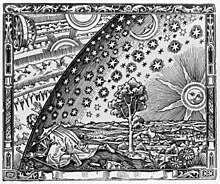 The Flammarion engraving (1888) depicts a man crawling under the edge of the sky, depicted as if it were a solid hemisphere, to look at the mysterious Empyrean beyond. The caption underneath the engraving (not shown here) translates to "A medieval missionary tells that he has found the point where heaven and Earth meet..."The ancient Hebrews, like all the ancient peoples of the Near East, believed the sky was a solid dome with the Sun, Moon, planets and stars embedded in it.[14] Around the 4th to 3rd centuries BCE the Greeks, under the influence of Aristotle who argued that the heavens must be perfect and that a sphere was the perfect geometrical figure, exchanged this for a spherical Earth surrounded by solid spheres. This became the dominant model in the Classical and Medieval world-view, and even when Copernicus placed the Sun at the centre of the system he included an outer sphere that held the stars (and by having the earth rotate daily on its axis it allowed the firmament to be completely stationary). Tycho Brahe's studies of the nova of 1572 and the Comet of 1577 were the first major challenges to the idea that orbs existed as solid, incorruptible, material objects,[15] and in 1584 Giordano Bruno proposed a cosmology without a firmament: an infinite universe in which the stars are actually suns with their own planetary systems.[16] After Galileo began using a telescope to examine the sky it became harder to argue that the heavens were perfect, as Aristotelian philosophy required, and by 1630 the concept of solid orbs was no longer dominant.[15]
https://en.wikipedia.org/wiki/Firmament

 Topic: New Geocentrism Book by Robert Sungenis (Read 78198 times)