So, according to the prevailing FE model (a general model), the shape of the earth would have Antarctica not actually being a continent at the South pole, but rather an ice wall or perimeter around the outer edge.
So it would look something like this:
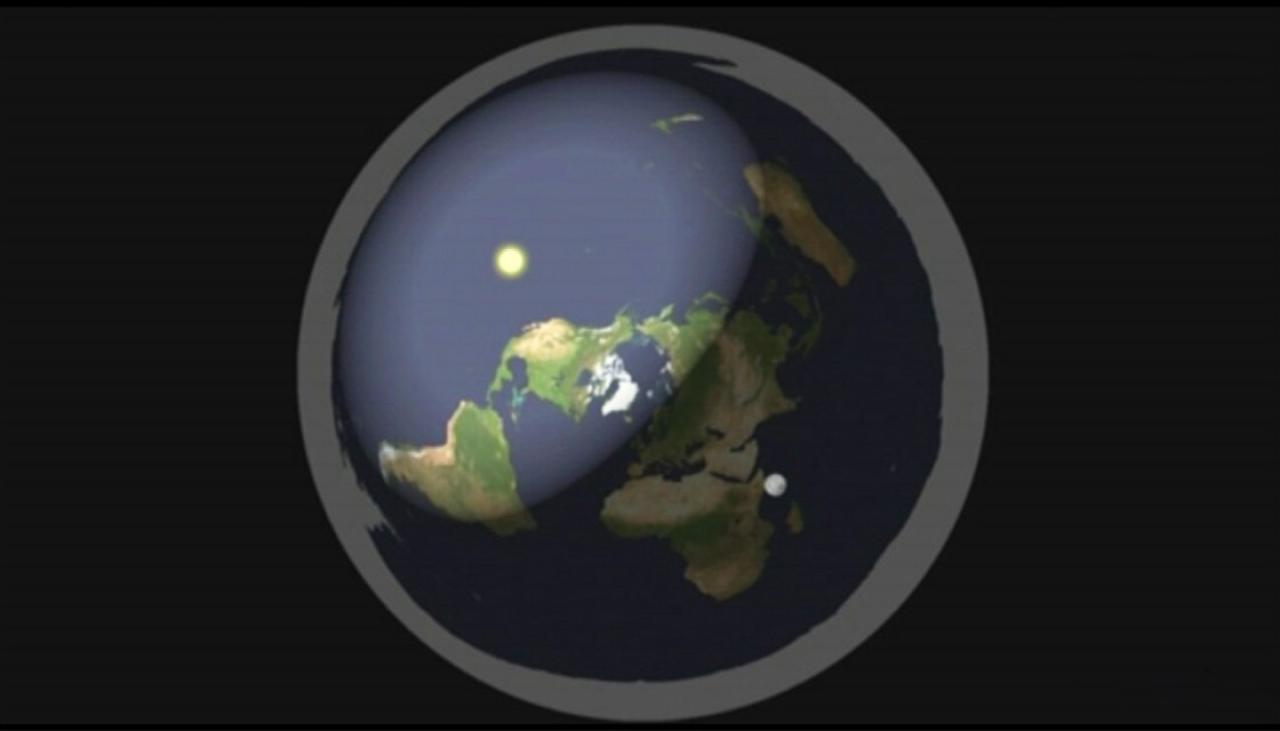
So because of that, when the sun is furthest south, at the tropic of Capricorn, it would be difficult to explain how it could continuously light up the entire circuit formed by Antarctica. There could be course be extensive illumination caused by reflection off the firmament, but this would not allow for illumination of the entire perimeter of Antarctica for 24 hours.
Okay, bear with me because I am new to this. I still believe the objections I raised earlier in this discussion refute the flat earth, and the more I think about them the more certain I am about it, but I have some other unrelated questions/points.
If I understood you correctly, what FE's call Antarctica is not a continent, but a circular ring of ice along the perimeter of the flat earth. The white part in the picture above. A difficulty for the FE's is that some claim Antarctica experiences light 24 hours a day (at certain periods of the year). But, according to the FE model, there's no way the perimeter could be lit up for 24 hours. Therefore, if Antarctica was truly lit up 24 hours a day, it would disprove FE.
One problem is that the same word is being used to describe two entirely different things. To everyone else, Antarctica is a continent in a particular location on the Earth. To the FE's, "Antarctica" is a large spherical shaped disc that surrounds the earth. The only thing that is the same is the word that is used to describe it.
Regarding the 24 hr light experiment, if a camera crew went to a location in Antarctica and proved that it was indeed light 24/7, it would only prove that it was light
in that particular location 24/7. I
f an FE set up in one location and had the same result, it would prove that it was light 24/7 at that particulate location of the disc. To prove it was light 24/7 in the entire sphere that FE's call Antarctica, camera crews would have to set up at hundreds of locations around the disc shaped perimeter at the same time. So, the difficulty for an FE is not trying to explain how the sun "
could continuously light up the entire circuit formed by Antarctica." It is to explain how the sun could light up one location 24/7.
The real difficulty is explaining how the sun could be above the surface of the flat earth, without everyone on earth seeing it. As I mentioned in my earlier objection, if the light of the sun is directional, and shines down on the earth like a flashlight, then you have to explain how the sun can appear circular above the horizon, and remain circular as it rises from one direction, passes over head, and then sets in the opposite direction, all the while appearing as a round disc. That's not possible if the sun is always above the earth and shining down on it, in a circular pattern, like a flashlight. That simple argument is what refutes the Fflt Earth theory.


 Topic: SSPX Article Against Flat-Erthism (Read 9881 times)