Send CathInfo's owner Matthew a gift from his Amazon wish list:
https://www.amazon.com/hz/wishlist/ls/25M2B8RERL1UO

Author Topic: Saint of the day  (Read 499830 times)

0 Members and 2 Guests are viewing this topic.

Re: Saint of the day
« Reply #20 on: December 25, 2023, 01:04:49 PM »
                                 
 Christmas Joy

The mystery of the Incarnation is a fitting theme of joy for both angels and men.
Therefore the Word of God, Himself God, the Son of God who “in the beginning was with God,” through whom “all things were made” and “without” whom “was nothing made" (John 1:1-3), with the purpose of delivering man from eternal death, became man: so bending Himself to take on Him our humility without decrease in His own majesty, that remaining what He was and assuming what He was not, He might unite the true form of a slave to that form in which He is equal to God the Father, and join both natures together by such a compact that the lower should not be swallowed up in its exaltation nor the higher impaired by its new associate.
Without detriment therefore to the properties of either substance which then came together in one person, majesty took on humility, strength weakness, eternity mortality: and for the paying off of the debt, belonging to our condition, inviolable nature was united with possible nature, and true God and true man were combined to form one Lord, so that, as suited the needs of our case, one and the same Mediator between God and men, the Man Christ Jesus, could both die with the one and rise again with the other.
Rightly therefore did the birth of our Salvation impart no corruption to the Virgin's purity, because the bearing of the Truth was the keeping of honor. Such then beloved was the Nativity which became the Power of God and the Wisdom of God even Christ, whereby He might be one with us in manhood and surpass us in Godhead. For unless He were true God, He would not bring us a remedy, unless He were true Man, He would not give us an example.
Therefore the exulting angel's song when the Lord was born is this, “Glory to God in the Highest,” and their message, “peace on earth to men of good will" (Luke 2:14). For they see that the heavenly Jerusalem is being built up out of all the nations of the world: and over that indescribable work of the Divine love how ought the humbleness of men to rejoice, when the joy of the lofty angels is so great?
Prayer to Jesus in the Manger
O Divine Redeemer Jesus Christ, prostrate before Thy crib, I believe Thou art the God of infinite Majesty, even though I do see Thee here as a helpless babe.
I humbly adore and thank Thee for having so humbled Thyself for my salvation as to will to be born in a stable. I thank Thee for all Thou didst wish to suffer for me in Bethlehem, for Thy poverty and humility, for Thy nakedness, tears, cold and sufferings.
Would that I could show Thee that tenderness which Thy Virgin Mother had toward Thee, and love Thee as she did.
Would that I could praise Thee with the joy of the angels, that I could kneel before Thee with the faith of St. Joseph, the simplicity of the shepherds.
Uniting myself with these first adorers at the crib, I offer Thee the homage of my heart, and I beg that Thou wouldst be born spiritually in my soul.
Make me reflect in some degree the virtues of Thy admirable nativity. Fill me with that spirit of renunciation, of poverty, of humility, which prompted Thee to assume the weakness of our nature, and to be born amid destitution and suffering.
Grant that from this day forward, I may in all things seek Thy greater glory, and may enjoy that peace promised to men of good wi


Re: Saint of the day
« Reply #21 on: December 28, 2023, 03:55:40 PM »
December 26


Stephen


Saint Stephen by Carlo Crivelli


Deacon, Archdeacon
Apostle of the Seventy
Protomartyr of The Faith
First Martyr


Born


c. 5 AD
Died


33–36 AD (aged 28–32)
Jerusalem, Judaea, Roman Empire
Venerated in


Roman Catholic Church
Eastern Catholic Churches
Orthodox Church
Oriental Orthodox Churches
Assyrian Church of the East
Anglican Communion
Lutheranism
Canonized


Pre-Congregation
Feast


25 December (Armenian Christianity)
26 December (Western)
27 December, 4 January, 2 August, 15 September (Eastern)
Tobi 1 (Coptic Christianity)
Attributes


Red Martyr, stones, dalmatic, censer, miniature church, Gospel Book, martyr's palm. In Orthodox and Eastern Christianity he often wears an orarion
Patronage


Altar Servers[1];Acoma Native American Pueblo; Bricklayers; casket makers; Cetona, Italy; deacons; headaches; horses; Kessel, Belgium; masons; Owensboro, Kentucky; Passau, Germany; Kigali, Rwanda; Dodoma, Tanzania; Serbia; Ligao; Republic of Srpska; Prato, Italy [2]
Stephen (Hebrew: סטפנוס, Greek: Στέφανος Stéphanos, meaning 'wreath or crown' and by extension 'reward, honor, renown, fame', often given as a title rather than as a name; c. 5 – c. 34 AD) is traditionally venerated as the protomartyr or first martyr of Christianity.[2] According to the Acts of the Apostles, he was a deacon in the early Church at Jerusalem who angered members of various ѕуηαgσgυєs by his teachings. Accused of blasphemy at his trial, he made a speech denouncing the Jєωιѕн authorities who were sitting in judgment on him[3] and was then stoned to death. Saul of Tarsus, later known as Paul, a Pharisee and Roman citizen who would later become a Christian apostle, participated in Stephen's martyrdom.[4]
The only source for information about Stephen is the New Testament book of the Acts of the Apostles.[5] Stephen is mentioned in Acts 6 as one of the Greek-speaking Hellenistic Jєωs selected to administer the daily charitable distribution of food to the Greek-speaking widows.[6]
The Catholic, Anglican, Oriental Orthodox, Eastern Orthodox, and Lutheran churches and the Church of the East view Stephen as a saint.[7] Artistic representations often show Stephen with a crown symbolising martyrdom, three stones, martyr's palm frond, censer, and often holding a miniature church building. Stephen is often shown as a young, beardless man with a tonsure, wearing a deacon's vestments.
Background[edit]
Stephen is first mentioned in the Acts of the Apostles as one of seven deacons appointed by the Apostles to distribute food and charitable aid to poorer members of the community in the early church. According to Orthodox belief, he was the eldest and is therefore called "archdeacon".[8] As another deacon, Nicholas of Antioch, is specifically stated to have been a convert to Judaism, it may be assumed that Stephen was born Jєωιѕн, but nothing more is known about his previous life.[5] The reason for the appointment of the deacons is stated to have been dissatisfaction among Hellenistic (that is, Greek-influenced and Greek-speaking) Jєωs that their widows were being slighted in preference to Hebraic ones in the daily distribution of food. Since the name "Stephanos" is Greek, it has been assumed that he was one of these Hellenistic Jєωs. Stephen is stated to have been full of faith and the Holy Spirit and to have performed miracles among the people.[9]
Stoning of Saint Stephen, altarpiece of San Giorgio Maggiore, Venice, by Jacopo & Domenico Tintoretto
It seems to have been among ѕуηαgσgυєs of Hellenistic Jєωs that he performed his teachings and "signs and wonders" since it is said that he aroused the opposition of the "ѕуηαgσgυє of the Freedmen", and "of the Cyrenians, and of the Alexandrians, and of them that were of Cilicia and Asia".[10] Members of these ѕуηαgσgυєs had challenged Stephen's teachings, but Stephen had bested them in debate. Furious at this humiliation, they suborned false testimony that Stephen had preached blasphemy against Moses and God. They dragged him to appear before the Sanhedrin, the supreme legal court of Jєωιѕн elders, accusing him of preaching against the Temple and the Mosaic Law.[11] Stephen is said to have been unperturbed, his face looking like "that of an angel".[5]
Speech to Sanhedrin[edit]
In a long speech to the Sanhedrin comprising almost the whole of Acts chapter 7, Stephen presents his view of the history of Israel. The God of glory, he says, appeared to Abraham in Mesopotamia, thus establishing at the beginning of the speech one of its major themes, that God does not dwell only in one particular building (meaning the Temple).[12] Stephen recounts the stories of the patriarchs in some depth, and goes into even more detail in the case of Moses. God appeared to Moses in the burning bush,[13] and inspired Moses to lead his people out of Egypt. Nevertheless, the Israelites turned to other gods.[14] This establishes the second main theme of Stephen's speech, Israel's disobedience to God.[12] Stephen faced two accusations: that he had declared that Jesus would destroy the Temple in Jerusalem and that he had changed the customs of Moses. Pope Benedict XVI stated in 2012 that St. Stephen appealed to the Jєωιѕн scriptures to prove how the laws of Moses were not subverted by Jesus but, instead, were being fulfilled.[15] Stephen denounces his listeners[12] as "stiff-necked" people who, just as their ancestors had done, resist the Holy Spirit. "Was there ever a prophet your ancestors did not persecute? They even killed those who predicted the coming of the Righteous One. And now you have betrayed and murdered him."[16]
The stoning of Stephen[edit]
Stoning of Saint Stephen by Giovanni Battista Lucini
Thus castigated, the account is that the crowd could contain their anger no longer.[17] However, Stephen looked up and cried, "Look! I see heaven open and the Son of Man standing on the right hand of God!" He said that the recently resurrected Jesus was standing by the side of God.[18][19] The people from the crowd, who threw the first stones,[20][18] laid their coats down so as to be able to do this, at the feet of a "young man named Saul" (later identified as Paul the Apostle). Stephen prayed that the Lord would receive his spirit and his killers be forgiven, sank to his knees, and "fell asleep".[21] Saul "approved of their killing him."[22] In the aftermath of Stephen's death, the remaining disciples except for the apostles fled to distant lands, many to Antioch.[23][24]
Location of the martyrdom[edit]
The exact site of Stephen's stoning is not mentioned in Acts; instead there are two different traditions. One, claimed by noted French archaeologists Louis-Hugues Vincent (1872–1960) and Félix-Marie Abel (1878–1953) to be ancient, places the event at Jerusalem's northern gate, while another one, dated by Vincent and Abel to the Middle Ages and no earlier than the 12th century, locates it at the eastern gate.[25]


Re: Saint of the day
« Reply #22 on: December 28, 2023, 04:03:46 PM »
December 27
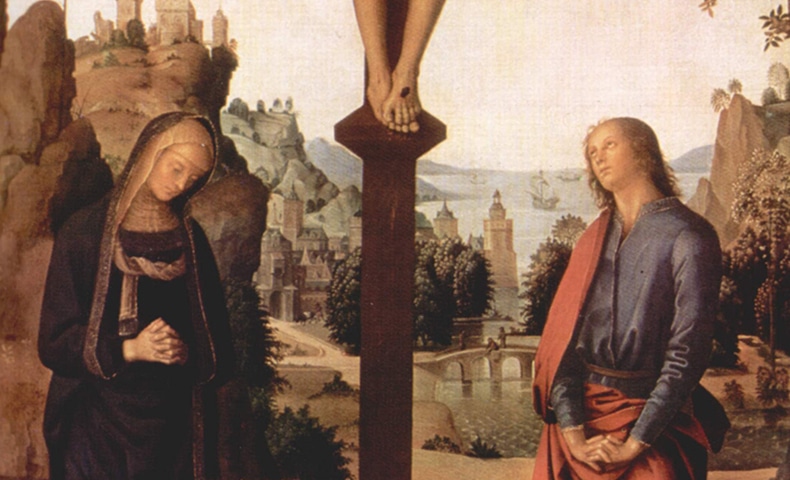
Saint John the Evangelist

[color=var(--e-global-color-text)]Image: Detail of the central panel of a triptych | Crucifixion with the Virgin and St. John | Pietro Perugino | photo by The Yorck Project[/font]
[/color]
[/size][/b]
Saint John the Evangelist’s Story
It is God who calls; human beings answer. The vocation of John and his brother James is stated very simply in the Gospels, along with that of Peter and his brother Andrew: Jesus called them; they followed. The absoluteness of their response is indicated by the account. James and John “were in a boat, with their father Zebedee, mending their nets. He called them, and immediately they left their boat and their father and followed him” (Matthew 4:21b-22).

For the three former fishermen—Peter, James and John—that faith was to be rewarded by a special friendship with Jesus. They alone were privileged to be present at the Transfiguration, the raising of the daughter of Jairus and the agony in Gethsemane. But John’s friendship was even more special. Tradition assigns to him the Fourth Gospel, although most modern Scripture scholars think it unlikely that the apostle and the evangelist are the same person.

John’s own Gospel refers to him as “the disciple whom Jesus loved” (see John 13:23; 19:26; 20:2), the one who reclined next to Jesus at the Last Supper, and the one to whom Jesus gave the exquisite honor of caring for his mother, as John stood beneath the cross. “Woman, behold your son…. Behold, your mother” (John 19:26b, 27b).

Because of the depth of his Gospel, John is usually thought of as the eagle of theology, soaring in high regions that other writers did not enter. But the ever-frank Gospels reveal some very human traits. Jesus gave James and John the nickname, “sons of thunder.” While it is difficult to know exactly what this meant, a clue is given in two incidents.

In the first, as Matthew tells it, their mother asked that they might sit in the places of honor in Jesus’ kingdom—one on his right hand, one on his left. When Jesus asked them if they could drink the cup he would drink and be baptized with his baptism of pain, they blithely answered, “We can!” Jesus said that they would indeed share his cup, but that sitting at his right hand was not his to give. It was for those to whom it had been reserved by the Father. The other apostles were indignant at the mistaken ambition of the brothers, and Jesus took the occasion to teach them the true nature of authority: “…[W]hoever wishes to be first among you shall be your slave. Just so, the Son of Man did not come to be served but to serve and to give his life as a ransom for many” (Matthew 20:27-28).

On another occasion, the “sons of thunder” asked Jesus if they should not call down fire from heaven upon the inhospitable Samaritans, who would not welcome Jesus because he was on his way to Jerusalem. But Jesus “turned and rebuked them” (see Luke 9:51-55).

On the first Easter, Mary Magdalene “ran and went to Simon Peter and to the other disciple whom Jesus loved, and told them, ‘They have taken the Lord from the tomb, and we don’t know where they put him’” (John 20:2). John recalls, perhaps with a smile, that he and Peter ran side by side, but then “the other disciple ran faster than Peter and arrived at the tomb first” (John 20:4b). He did not enter, but waited for Peter and let him go in first. “Then the other disciple also went in, the one who had arrived at the tomb first, and he saw and believed” (John 20:8).

John was with Peter when the first great miracle after the Resurrection took place—the cure of the man crippled from birth—which led to their spending the night in jail together. The mysterious experience of the Resurrection is perhaps best contained in the words of Acts: “Observing the boldness of Peter and John and perceiving them to be uneducated, ordinary men, they [the questioners] were amazed, and they recognized them as the companions of Jesus” (Acts 4:13).
The Apostle John is traditionally considered the author also of three New Testament letters and the Book of Revelation. His Gospel is a very personal account. He sees the glorious and divine Jesus already in the incidents of his mortal life. At the Last Supper, John’s Jesus speaks as if he were already in heaven. John’s is the Gospel of Jesus’ glory.


Re: Saint of the day
« Reply #23 on: December 28, 2023, 04:07:41 PM »
[color=var(--e-global-color-text)]Holy Innocents[/font][/size][/color]
Patinting of the Holy Innocents
[color=var(--e-global-color-text)]Image: The Massacre of the Innocents | Angelo Visconti
[/font][/size][/color]


[color=var(--e-global-color-text)]Saints of the Day for December 28


[/font][/size][/color]


The Story of the Holy Innocents
Herod “the Great,” king of Judea, was unpopular with his people because of his connections with the Romans and his religious indifference. Hence he was insecure and fearful of any threat to his throne. He was a master politician and a tyrant capable of extreme brutality. He killed his wife, his brother, and his sister’s two husbands, to name only a few.
Matthew 2:1-18 tells this story: Herod was “greatly troubled” when astrologers from the east came asking the whereabouts of “the newborn king of the Jєωs,” whose star they had seen. They were told that the Jєωιѕн Scriptures named Bethlehem as the place where the Messiah would be born. Herod cunningly told them to report back to him so that he could also “do him homage.” They found Jesus, offered him their gifts, and warned by an angel, avoided Herod on their way home. Jesus escaped to Egypt.
Herod became furious and “ordered the massacre of all the boys in Bethlehem and its vicinity two years old and under.” The horror of the massacre and the devastation of the mothers and fathers led Matthew to quote Jeremiah: “A voice was heard in Ramah, sobbing and loud lamentation; Rachel weeping for her children…” (Matthew 2:18). Rachel was the wife of Jacob (Israel). She is pictured as weeping at the place where the Israelites were herded together by the conquering Assyrians for their march into captivity.


Reflection
The Holy Innocents are few in comparison to the genocide and abortion of our day. But even if there had been only one, we recognize the greatest treasure God put on the earth—a human person, destined for eternity, and graced by Jesus’ death and resurrection.


The Holy Innocents are the Patron Saints of:
Babies


Re: Saint of the day
« Reply #24 on: December 28, 2023, 04:15:24 PM »
Click to Watch the St. Thomas Becket video title=Click to Watch the St. Thomas Becket video
Feastday: December 29
Birth: 1118
Death: 1170
Author and Publisher - Catholic Online


Image of St. Thomas Becket title=Image of St. Thomas BecketAccording to a contemporary writer, Thomas Becket was the son of Gilbert Becket, sheriff of London; another relates that both parents were of Norman blood. Whatever his parentage, we know with certainty that the future chancellor and archbishop of Canterbury was born on St. Thomas day, 1118, of a good family, and that he was educated at a school of canons regular at Merton Priory in Sussex, and later at the University of Paris. When Thomas returned from France, his parents had died. Obliged to make his way unaided, he obtained an appointment as clerk to the sheriff's court, where he showed great ability. All accounts describe him as a strongly built, spirited youth, a lover of field sports, who seems to have spent his leisure time in hawking and hunting. One day when he was out hunting with his falcon, the bird swooped down at a duck, and as the duck dived, plunged after it into the river. Thomas himself leapt in to save the valuable hawk, and the rapid stream swept him along to a mill, where only the accidental stopping of the wheel saved his life. The episode serves to illustrate the impetuous daring which characterized Becket all through his life.

At the age of twenty-four Thomas was given a post in the household of Theobald, archbishop of Canterbury, and while there he apparently resolved on a career in the Church, for he took minor orders. To prepare himself further, he obtained the archbishop's permission to study canon law at the University of Bologna, continuing his studies at Auxerre, France. On coming back to England, he became provost of Beverley, and canon at Lincoln and St. Paul's cathedrals. His ordination as deacon occurred in 1154. Theobald appointed him archdeacon of Canterbury, the highest ecclesiastical office in England after a bishopric or an abbacy, and began to entrust him with the most intricate affairs; several times he was sent on important missions to Rome. It was Thomas' diplomacy that dissuaded Pope Eugenius III from sanctioning the coronation of Eustace, eldest son of Stephen, and when Henry of Anjou, great grandson of William the Conqueror, asserted his claim to the English crown and became King Henry II, it was not long before he appointed this gifted churchman as chancellor, that is, chief minister. An old chronicle describes Thomas as "slim of growth, and pale of hue, with dark hair, a long nose, and a straightly featured face.

Blithe of countenance was he, winning and lovable in conversation, frank of speech in his discourses but slightly stuttering in his talk, so keen of discernment that he could always make difficult questions plain after a wise manner." Thomas discharged his duties as chancellor conscientiously and well.

Like the later chancellor of the realm, Thomas Moore, who also became a martyr and a saint, Thomas Becket was the close personal friend as well as the loyal servant of his young sovereign. They were said to have one heart and one mind between them, and it seems possible that to Becket's influence were due, in part, those reforms for which Henry is justly praised, that is, his measures to secure equitable dealing for all his subjects by a more uniform and efficient system of law. But it was not only their common interest in matters of state that bound them together. They were also boon companions and spent merry hours together. It was almost the only relaxation Thomas allowed himself, for he was an ambitious man. He had a taste for magnificence, and his household was as fine--if not finer--than the King's. When he was sent to France to negotiate a royal marriage, he took a personal retinue of two hundred men, with a train of several hundred more, knights and squires, clerics and servants, eight fine wagons, music and singers, hawks and hounds, monkeys and mastiffs. Little wonder that the French gaped in wonder and asked, "If this is the chancellor's state, what can the King's be like?" His entertainments, his gifts, and his liberality to the poor were also on a very lavish scale.

In 1159 King Henry raised an army of mercenaries in France to regain the province of Toulouse, a part of the inheritance of his wife, the famous Eleanor of Aquitaine.

Thomas served Henry in this war with a company of seven hundred knights of his own. Wearing armor like any other fighting man, he led assaults and engaged in single combat. Another churchman, meeting him, exclaimed: "What do you mean by wearing such a dress? You look more like a falconer than a cleric. Yet you are a cleric in person, and many times over in office-archdeacon of Canterbury, dean of Hastings, provost of Beverley, canon of this church and that, procurator of the archbishop, and like to be archbishop, too, the rumor goes!" Thomas received the rebuke with good humor.

Although he was proud, strong-willed, and irascible, and remained so all his life, he did not neglect to make seasonal retreats at Merton and took the discipline imposed on him there. His confessor during this time testified later to the blamelessness of his private life, under conditions of extreme temptation. If he sometimes went too far in those schemes of the King which tended to infringe on the ancient prerogatives and rights of the Church, at other times he opposed Henry with vigor.

In 1161 Archbishop Theobald died. King Henry was then in Normandy with Thomas, whom he resolved to make the next primate of England. When Henry announced his intention, Thomas, demurring, told him: "Should God permit me to be the archbishop of Canterbury, I would soon lose your Majesty's favor, and the affection with which you honor me would be changed into hatred. For there are several things you do now in prejudice of the rights of the Church which make me fear you would require of me what I could not agree to; and envious persons would not fail to make it the occasion of endless strife between us." The King paid no heed to this remonstrance, and sent bishops and noblemen to the monks of Canterbury, ordering them to labor with the same zeal to set his chancellor in the see as they would to set the crown on the young prince's head. Thomas continued to refuse the promotion until the legate of the Holy See, Cardinal Henry of Pisa, overrode his scruples. The election took place in May, 1162. Young Prince Henry, then in London, gave the necessary consent in his father's name. Thomas, now forty-four years old, rode to Canterbury and was first ordained priest by Walter, bishop of Rochester, and then on the octave of Pentecost was consecrated archbishop by the bishop of Winchester. Shortly afterwards he received the pallium sent by Pope Alexander III.

From this day worldly grandeur no longer marked Thomas' way of life. Next his skin he wore a hairshirt, and his customary dress was a plain black cassock, a linen surplice, and a sacerdotal stole about his neck. He lived ascetically, spent much time in the distribution of alms, in reading and discussing the Scriptures with Herbert of Bosham, in visiting the infirmary, and supervising the monks at their work. He took special care in selecting candidates for Holy Orders. As ecclesiastical judge, he was rigorously just.

Although as archbishop Thomas had resigned the chancellorship, against the King's wish, the relations between the two men seemed to be unchanged for a time. But a host of troubles was brewing, and the crux of all of them was the relationship between Church and state. In the past the landowners, among which the Church was one of the largest, for each hide [1] of land they held, had paid annually two shillings to the King's officers, who in return undertook to protect them from the rapacity of minor tax- gatherers. This was actually a flagrant form of graft and the King now ordered the money paid into his own exchequer. The archbishop protested, and there were hot words between him and the King. Thenceforth the King's demands were directed solely against the clergy, with no mention of other landholders who were equally involved.

Then came the affair of Philip de Brois, a canon accused of murdering a soldier.

According to a long-established law, as a cleric he was tried in an ecclesiastical court, where he was acquitted by the judge, the bishop of Lincoln, but ordered to pay a fine to the deceased man's relations. A king's justice then made an effort to bring him before his civil court, but he could not be tried again upon that indictment and told the king's justice so in insulting terms. Thereat Henry ordered him tried again both for the original murder charge--and for his later misdemeanor. Thomas now pressed to have the case referred to his own archiepiscopal court; the King reluctantly agreed, and appointed both lay and clerical assessors. Philip's plea of a previous acquittal was accepted as far as the murder was concerned, but he was punished for his contempt of a royal court. The King thought the sentence too mild and remained dissatisfied. In October, 1163, the King called the bishops of his realm to a council at Westminster, at which he demanded their assent to an edict that thenceforth clergy proved guilty of crimes against the civil law should be handed over to the civil courts for punishment.

Thomas stiffened the bishops against yielding. But finally, at the council of Westminster they assented reluctantly to the instrument known as the Constitutions of Clarendon, which embodied the royal "customs" in Church matters, and including some additional points, making sixteen in all. It was a revolutionary docuмent: it provided that no prelate should leave the kingdom without royal permission, which would serve to prevent appeals to the Pope; that no tenant-in-chief should be excommunicated against the King's will; that the royal court was to decide in which court clerics accused of civil offenses should be tried; that the custody of vacant Church benefices and their revenues should go to the King. Other provisions were equally damaging to the authority and prestige of the Church. The bishops gave their assent only with a reservation, "saving their order," which was tantamount to a refusal.

Thomas was now full of remorse for having weakened, thus setting a bad example to the bishops, but at the same time he did not wish to widen the breach between himself and the King. He made a futile effort to cross the Channel and put the case before the Pope. On his part, the King was bent on vengeance for what he considered the disloyalty and ingratitude of the archbishop. He ordered Thomas to give up certain castles and honors which he held from him, and began a campaign to persecute and discredit him. Various charges of chicanery and financial dishonesty were brought against Thomas, dating from the time he was chancellor. The bishop of Winchester pleaded the archbishop's discharge. The plea was disallowed; Thomas offered a voluntary payment of his own money, and that was refused.

The affair was building up to a crisis, when, on October 13, 1164, the King called another great council at Northampton. Thomas went, after celebrating Mass, carrying his archbishop's cross in his hand. The Earl of Leicester came out with a message from the King: "The King commands you to render your accounts. Otherwise you must hear his judgment." "Judgment?" exclaimed Thomas. "I was given the church of Canterbury free from temporal obligations. I am therefore not liable and will not plead with regard to them. Neither law nor reason allows children to judge and condemn their fathers.

Wherefore I refuse the King's judgment and yours and everyone's. Under God, I will be judged by the Pope alone."

Determined to stand out against the King, Thomas left Northampton that night, and soon thereafter embarked secretly for Flanders. Louis VII, King of France, invited Thomas into his dominions. Meanwhile King Henry forbade anyone to give him aid.

Gilbert, abbot of Sempringham, was accused of having sent him some relief. Although the abbot had done nothing, he refused to swear he had not, because, he said, it would have been a good deed and he would say nothing that might seem to brand it as a criminal act. Henry quickly dispatched several bishops and others to put his case before Pope Alexander, who was then at Sens. Thomas also presented himself to the Pope and showed him the Constitutions of Clarendon, some of which Alexander pronounced intolerable, others impossible. He rebuked Thomas for ever having considered accepting them. The next day Thomas confessed that he had, though unwillingly, received the see of Canterbury by an election somewhat irregular and uncanonical, and had acquitted himself badly in it. He resigned his office, returned the episcopal ring to the Pope, and withdrew. After deliberation, the Pope called him back and reinstated him, with orders not to abandon his office, for to do so would be to abandon the cause of God. He then recommended Thomas to the Cistercian abbot at Pontigny.

Thomas then put on a monk's habit, and submitted himself to the strict rule of the monastery. Over in England King Henry was busy confiscating the goods of all the friends, relations, and servants of the archbishop, and banishing them, first binding them by oath to go to Thomas at Pontigny, that the sight of their distress might move him. Troops of these exiles soon appeared at the abbey. Then Henry notified the Cistercians that if they continued to harbor his enemy he would sequestrate all their houses in his dominions. After this, the abbot hinted that Thomas was no longer welcome in his abbey. The archbishop found refuge as the guest of King Louis at the royal abbey of St. Columba, near Sens.

This historic quarrel dragged on for three years. Thomas was named by the Pope as his legate for all England except York, whereupon Thomas excommunicated several of his adversaries; yet at times he showed himself conciliatory towards the King. The French king was also drawn into the struggle, and the two kings had a conference in 1169 at Montmirail. King Louis was inclined to take Thomas' side. A reconciliation was finally effected between Thomas and Henry, although the lines of power were not too clearly drawn. The archbishop now made preparations to return to his see. With a premonition of his fate, he remarked to the bishop of Paris in parting, "I am going to England to die." On December 1, 1172, he disembarked at Sandwich, and on the journey to Canterbury the way was lined with cheering people, welcoming him home. As he rode into the cathedral city at the head of a triumphal procession, every bell was ringing. Yet in spite of the public demonstration, there was an atmosphere of foreboding.

At the reconciliation in France, Henry had agreed to the punishment of Roger, archbishop of York, and the bishops of London and Salisbury, who had assisted at the coronation of Henry's son, despite the long-established right of the archbishop of Canterbury to perform this ceremony and in defiance of the Pope's explicit instructions. It had been another attempt to lower the prestige of the primate's see. Thomas had sent on in advance of his return the papal letters suspending Roger and confirming the excommunication of the two bishops involved. On the eve of his arrival a deputation waited on him to ask for the withdrawal of these sentences. He agreed on condition that the three would swear thenceforth to obey the Pope. This they refused to do, and together went to rejoin King Henry, who was visiting his domains in France.

At Canterbury Thomas was subjected to insult by one Ranulf de Broc, from whom he had demanded the restoration of Saltwood Castle, a manor previously belonging to the archbishop's see. After a week's stay there he went up to London, where Henry's son, "the young King," refused to see him. He arrived back in Canterbury on or about his fifty-second birthday. Meanwhile the three bishops had laid their complaints before the King at Bur, near Bayeux, and someone had exclaimed aloud that there would be no peace for the realm while Becket lived. At this, the King, in a fit of rage, pronounced some words which several of his hearers took as a rebuke to them for allowing Becket to continue to live and thereby disturb him. Four of his knights at once set off for England and made their way to the irate family at Saltwood. Their names were Reginald Fitzurse, William de Tracy, Hugh de Morville, and Richard le Bret.

On St. John's day Thomas received a letter warning him of danger, and all southeast Kent was in a state of ferment. On the afternoon of December 29, the four knights came to see him in his episcopal palace. During the interview they made several demands, in particular that Thomas remove the censures on the three bishops. The knights withdrew, uttering threats and oaths. A few minutes later there were loud outcries, a shattering of doors and clashing of arms, and the archbishop, urged on by his attendants, began moving slowly through the cloister passage to the cathedral. It was now twilight and vespers were being sung. At the door of the north transept he was met by some terrified monks, whom he commanded to get back to the choir. They withdrew a little and he entered the church, but the knights were seen behind him in the dim light. The monks slammed the door on them and bolted it. In their confusion they shut out several of their own brethren, who began beating loudly on the door.

Becket turned and cried, "Away, you cowards ! A church is not a castle." He reopened the door himself, then went towards the choir, accompanied by Robert de Merton, his aged teacher and confessor, William Fitzstephen, a cleric in his household, and a monk, Edward Grim. The others fled to the crypt and other hiding places, and Grim alone remained. At this point the knights broke in shouting, "Where is Thomas the traitor?" "Where is the archbishop?" "Here I am," he replied, "no traitor, but archbishop and priest of God!" He came down the steps to stand between the altars of Our Lady and St. Benedict.

The knights clamored at him to absolve the bishops, and Thomas answered firmly, "I cannot do other than I have done. Reginald, you have received many favors from me.

Why do you come into my church armed?" Fitzurse made a threatening gesture with his axe. "I am ready to die," said Thomas, "but God's curse on you if you harm my people." There was some scuffling as they tried to carry Thomas outside bodily.

Fitzurse flung down his axe and drew his sword. "You pander, you owe me fealty and submission!" exclaimed the archbishop. Fitzurse shouted back, "I owe no fealty contrary to the King ! " and knocked off Thomas' cap. At this, Thomas covered his face and called aloud on God and the saints. Tracy struck a blow, which Grim intercepted with his own arm, but it grazed Thomas' skull and blood ran down into his eyes. He wiped the stain away and cried, "Into Thy hands, O Lord, I commend my spirit!" Another blow from Tracy beat him to his knees, and he pitched forward onto his face, murmuring, "For the name of Jesus and in defense of the Church I am willing to die." With a vigorous thrust Le Bret struck deep into his head, breaking his sword against the pavement, and Hugh of Horsea added a blow, although the archbishop was now dying. Hugh de Morville stood by but struck no blow. The murderers, brandishing their swords, now dashed away through the cloisters, shouting "The King's men! The King's men!" The cathedral itself was filling with people unaware of the catastrophe, and a thunderstorm was breaking overhead.[2] The archbishop's body lay in the middle of the transept, and for a time no one dared approach it. A deed of such sacrilege was bound to be regarded with horror and indignation. When the news was brought to the King, he shut himself up and fasted for forty days, for he knew that his chance remark had sped the courtiers to England bent on vengeance. He later performed public penance in Canterbury Cathedral and in 1172 received absolution from the papal delegates.

Within three years of his death the archbishop had been canonized as a martyr. Though far from a faultless character, Thomas Becket, when his time of testing came, had the courage to lay down his life to defend the ancient rights of the Church against an aggressive state. The discovery of his hairshirt and other evidences of austerity, and the many miracles which were reported at his tomb, increased the veneration in which he was held. The shrine of the "holy blessed martyr," as Chaucer called him, soon became famous, and the old Roman road running from London to Canterbury known as "Pilgrim's Way." His tomb was magnificently adorned with gold, silver, and Jєωels, only to be despoiled by Henry VIII; the fate of his relics is uncertain. They may have been destroyed as a part of Henry's policy to subordinate the English Church to the civil authority. Mementoes of this saint are preserved at the cathedral of Sens. The feast of St. Thomas of Canterbury is now kept throughout the Roman Catholic Church, and in England he is regarded as the protector of the secular clergy.