Just sharing..
EUCHARISTIC MIRACLE OF SIENA 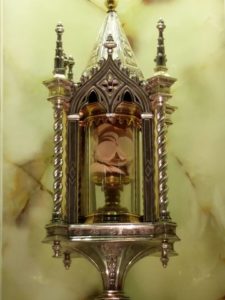
Eucharistic miracle of Siena (Basilica di S. Francesco, Siena)
Basilica di San Francesco (Piazza San Francesco 6; daily 7:30am-12pm/3:30-7pm; www.enjoysiena.it/en/attrattore/Basilica-of-San-Francesco/) Siena is also home to a Eucharistic miracle which is one of the longest ongoing miracles in the world. Like the other permanent (continuous) Eucharistic miracles preserved to this day (most famous of which are in Lanciano, Italy, and Santarem, Portugal), it is a gift of God’s love meant to strengthen our faith in the Real Presence of Our Lord in the Eucharist.
On August 14, 1730, thieves broke into the Church of St. Francis and stole a ciborium containing consecrated hosts. The theft was discovered the next day by Franciscan priests, and the town’s festivities celebrating the Feast of the Assumption were immediately halted. The bishop asked for prayers and reparations as civil authorities searched for the missing ciborium and hosts.
On August 17, a parishioner in the Church of St. Mary noticed a bright light coming from a collection box. When the box was opened a large number of hosts was discovered covered by dust and cobwebs. Counted and examined, these were determined to be the same hosts (348 whole hosts and 6 halves) that were stolen.
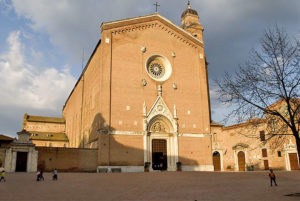
Basilica di San Francesco, Siena
On August 18, the archbishop of Siena, in a magnificent procession, carried the hosts (placed in a ciborium) back to the Church of St. Francis. A huge crowd of people from all walks of life and social classes followed the archbishop and the clergy of Siena along streets which had been decorated for the joyous occasion.
Normally the priests would have consumed these hosts but since the dust and dirt could not be entirely removed from them it was decided to let them decompose naturally, something that should have taken a few weeks. But the hosts did not decompose. They have remained as fresh and as pleasant smelling as on the day they were first baked.
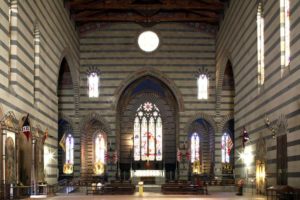
Basilica di San Francesco, Siena
Over the years various examinations and tests have been performed that authenticate this miracle. The first official investigation took place in 1780. The hosts were examined and tasted, and confirmed to be fresh and incorrupt. Further investigations by special commissions were done in 1789, 1815 and 1850. During the 1789 examination the archbishop had several
unconsecrated hosts placed in a sealed box which was then kept under lock in the chancery office. When it was opened, several years later, the hosts were found disfigured and extremely deteriorated.
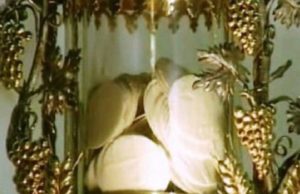
The sacred hosts (sacre particole) of Siena
The most significant investigation took place in 1914 by a special commission composed of various Italian scientists and professors, as well as several theologians and Church officials. An acid and starch test was performed, and particles of the hosts were again tasted. It was determined that he hosts had been made of roughly sifted wheat flour and that they were perfectly preserved. The commission agreed that unleavened bread, prepared and kept under ordinary conditions (as was the case with these hosts) could not have remained intact for such a long time, and that no natural explanation could be found to explain the remarkable preservation of bread since 1730.
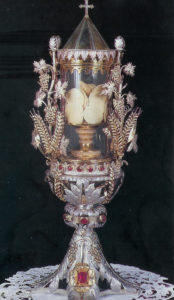
Eucharistic miracle of Siena
In 1922 cardinal Tacci, accompanied by the archbishop of Siena and four bishops, again examined the miraculous hosts. As in all previous examinations, they were found to be perfectly preserved and fresh tasting. Yet another investigation took place in 1950 when the hosts were transferred to a more elaborate container. By this time there were 223 hosts, the others having been distributed in communion on a few occasions and used in tasting during the various examinations.
On August 5, 1951, another sacrilegious theft took place in the Church of St. Francis involving the miraculous hosts. This time, however, the thief took only the precious container, leaving the hosts on the altar. The archbishop then placed the hosts in a silver ciborium, and sealed it. The following year the archbishop, in the presence of a number of witnesses, took the hosts out of the ciborium, counted and examined them, and had them photographed. They were then transferred into an elaborate monstrance specially constructed for this purpose.
The most recent examination of the sacred hosts was carried out in 2014. It included surface investigation under digital microscope, determination of the nucleotide adenosine triphosphate (ATP), culture tests, etc. It confirmed the hosts remain unchanged and free from any abnormalities or decay, contrary to the laws of nature.
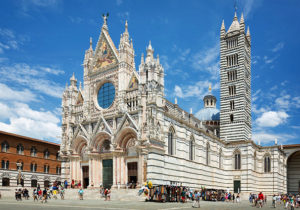
Duomo (cathedral) of Siena
The 223 miraculous hosts are preserved to this day in the church (now Basilica) of Saint Francis. They are publicly displayed several times a year, including on the 17th day of each month (which was the day of the month that they were discovered by the parishioner). On the Feast of Corpus Christi the hosts are taken in procession through the streets of Siena.
While in Siena, make sure to also visit the beautiful cathedral (Duomo). For a handy list – with contacts, opening hours and main attractions – of all the churches and sanctuaries in Siena, see the link
here.


 Topic: Eucharistic Miracle of Siena (Read 3242 times)