Send CathInfo's owner Matthew a gift from his Amazon wish list:
https://www.amazon.com/hz/wishlist/ls/25M2B8RERL1UO

Author Topic: Concordantiae Caritatis  (Read 4778 times)

0 Members and 2 Guests are viewing this topic.

Re: Concordantiae Caritatis
« Reply #15 on: June 24, 2026, 08:01:23 AM »

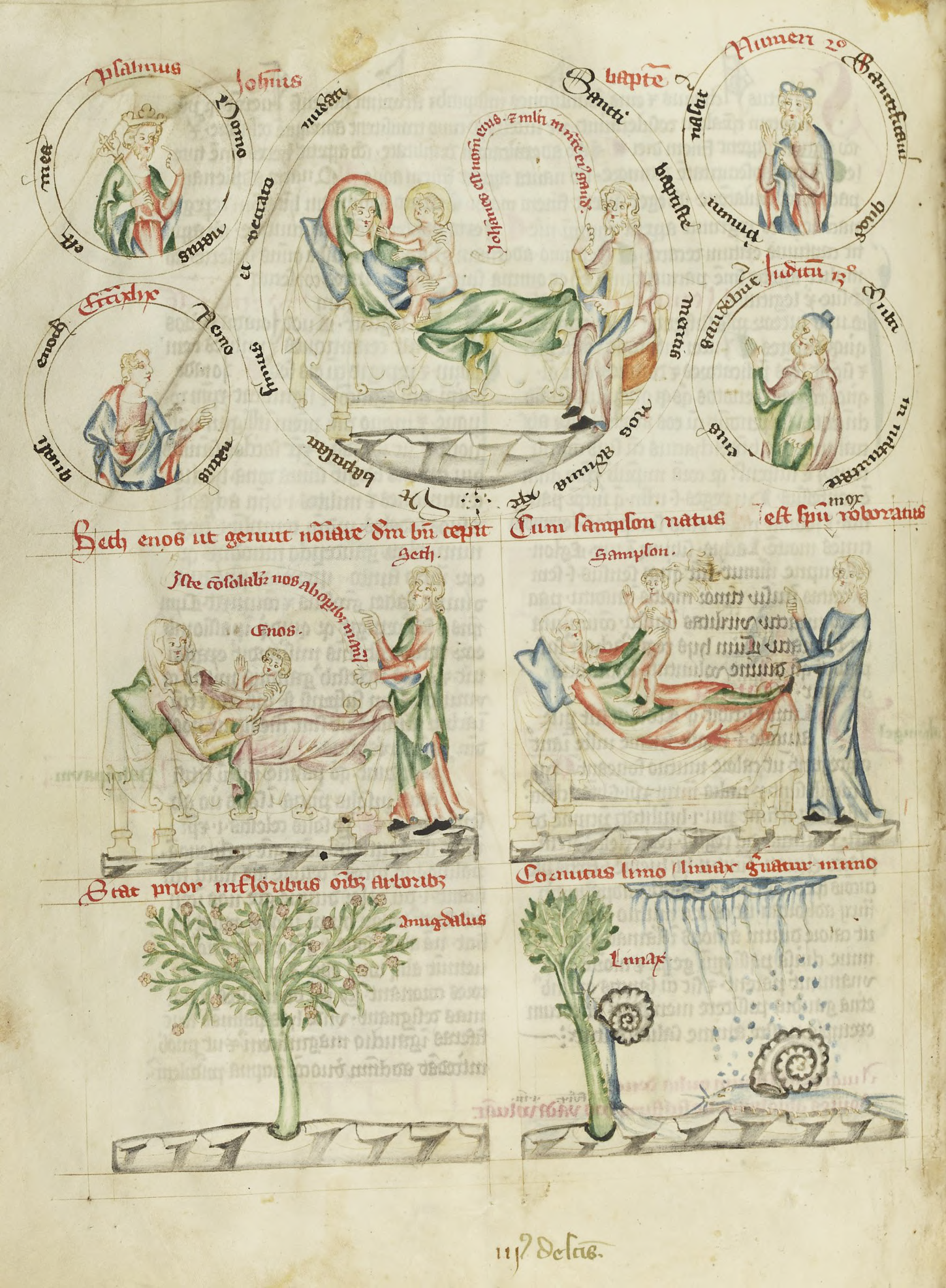
Nativity of Saint John the Baptist
By Udalricus Campiliensis († c. 1358)
(AI Translation)


The Lord specially commended blessed John when He said: "Among those born of women..."
His main dignities are:
First,  that his announcement was made in the Temple and not in the bridal chamber
Second, his announcement was made during the holy liturgical services
Third, that he was announced by the same angel as Christ.
Fourth, that at the arrival of the Mother of Christ, the blessed child leaped in his mother’s womb.
Fifth, that he was sanctified in the womb by the Holy Spirit.
Sixth, that he preached the heavenly kingdom to the great penitents, and forgiveness to sinners
Seventh, that he never lost the grace of God, keeping it even in venial matters.
Eighth, that living in great austerity, he subjected his body.
Ninth, that more than a prophet, he pointed out the Lord with his finger Tenth, that he baptized the Lord with his own hands; wherefore, when the Lord mentioned John, He exalted him above all others.

Old Testament (left)
It is read in Genesis 4: "Seth begat Enos, and he began to call upon the name of the Lord" [Gen 4:26]
Seth is interpreted as "a shoot" and signifies Zechariah, who, by the nod of God, brought forth a shoot and begat blessed John the Baptist. Enos, however, is interpreted as "invoking," and signifies blessed John, who, while in his mother's womb, recognized and invoked the Lord
He began to call upon the Lord, and from his earliest age became a refugee in the deserts, living off the harshest of food and in the harshest of clothing, remaining there for the sake of preaching. There, amidst the disturbances and the twofold viper of the world and the flesh, he began to call upon the name of the Lord manfully, even becoming consoler and a preacher unto others, and so he continued until his own consummation, that he might receive the heavenly prize through the palm of martyrdom, so that we celebrate not just his martyrdom, but even his Nativity.

Old Testament (right)
The wife of Manoah bore him a son, Samson, who from birth they dedicated to the service of the Lord. Manoah is interpreted as 'rest,' signifying Zechariah, who found rest when he was struck mute and recognized his son John. Samson, meaning "illuminating them", signifies John. Serving those who are faithful and believing, he illuminated them so wondrously, preparing them through baptism for Christ. And that same Holy Spirit, who had filled holy John before his birth, began this work and perfected it from within, and it remains in this work of preparing men to receive Christ. And just as Samson was a judge, so in the Last Judgement shall John stand and judge alongside Christ.

Nature (left)
Isidore writes that the almond tree clothes itself with blossoms before all other trees. For just as the almond blossoms before all other trees, so did the blessed John the Baptist bring forth the flowers of virtue outwardly, through the fecundation of the Spirit. In his infancy, before all men, and before the Holy One—which is to say, the One who was to be born after him—he showed what holiness is; and he brought forth heavenly flowers of holiness to signify how greater the fruits of his adulthood would be.

The almond is of neither gender, or is its core of one sole nature, for it is both masculine and feminine; so this flowering almond, with fruits full of divine grace, John, was a bridge for both males and females, and a medium among all created men, and through his holiness he reached and spoke with all states of men, leading them to repentance and holy living. May we, who were also baptized by the Church, join John and his holy disciples, so that we may bless God for eternity.

Nature (right)
The Experimenter and the Liber Rerum say that the snail is generated in the mud at the bottom of sea by the rain, moves slowly, carries a shell upon itself, climbs to the summits of trees, and leaves tracks behind as it moves.
This signifies the blessed John the Baptist, who was generated by the rain of grace, so that as a man, through divine grace cooperating with him, he moved slowly - that is, with humility - and while still a boy, fled to seek the deserts. He carried a shell upon himself, the justice of God. He climbed to the summit of the tree, being of greater holiness than all the saints and angels (N.T. obviously excepting the Blessed Virgin). And he left a trace behind him, which means the authority and fame he had owing to his piety, good works, and perfection in holiness and justice.

Re: Concordantiae Caritatis
« Reply #16 on: June 28, 2026, 04:56:55 PM »
Fifth Sunday after Pentecost
By Udalricus Campiliensis († c. 1358)
(AI Translation)

In Matthew V it is read that the Lord commands not only not to kill, but not even to be angry. It is to be noted here that anger is a sudden movement of the soul, proceeding to deeds, from which destruction is generated. And of these movements, some arise from faint-heartedness, some from despair, some from sin, and some from carnality. But he who possesses faith, hope, charity, fortitude, and chastity will not fear these irascible impulses. For anger, in so far as it is a mortal sin, is to be avoided: because it inflicts harm upon the body, because it blinds the eye of the mind, because it makes one a slave of the devil, and because it brings with it eternal and spiritual death. All anger inflicts evil upon men and things, whether by brotherly hatred, by injury committed, by homicide or by the theft of one's reputation or any other good.

Old Testament (Left)
In Genesis XLIX it is said that Jacob spoke: "Simeon and Levi are vessels of war against their son; my soul shall not enter into their council." Just as the Lord does with the wrathful, so did Jacob not want the sons of fury to ever become princes. Jacob is the supplanter, that is, Christ, who supplants all things unto Himself, who ascended the heavens and supplants the evils from us when He helps us with His grace to be helped. His sons, that is, sinners or those who act precipitously, are all those Christians who are vessels of fury warring against one another, that is, showing no piety among themselves; for Simeon (meaning "one who hears of sorrow") and Levi (meaning "added") are so interpreted. That is, they shall hear the sorrow of mourning, and they add and add unto their own sin, being characterized by wrath, and therefore the Lord is never named in their council.

Old Testament (Right)
In Genesis XLV it is read that Joseph said to his brothers after he had manifested himself to them: "Do not become angry on the way." Just as the Lord commanded the disciples not to fret over vessels, so Joseph told his brothers not to fret on the journey, showing them how to control the movement of the soul. Joseph means "increase" and signifies Christ, who daily increases the number of those to be saved by His grace; and here, used by His brothers for all the faithful, He snatches them and imposes the final requirement that, in the way we live and walk through this present exile, we should in no way, through any matter of grumbling or detraction, rise up against ourselves or our neighbors in any manner, lest we fall into vices, violence, and lastly Gehenna, according to the evangelical sentence.

Nature (left)
Basil the Great says that the camel hides its anger for a long time until it can take revenge at an opportune moment. Thus does Christ act, who long dissembles His wrathful vengeance against the impious, yet afterwards harshly condemns those who are unwilling to convert. Hence, let no one neglect the mercy of God.

Alternatively, the camel signifies the hardened and long-suffering sinner who, unable to immediately repay an offense committed against him, patiently dissembles it; and when in time he gains power or opportunity, he takes his revenge, at no point forgetting or desisting from his evil purpose. This type of revenge makes the irate man himself suffer for a long time; may all be especially wary of this sickness and self-inflicted torture.

Nature (right)
Aristotle and the Experimentator say that children will play with monkeys, but when the monkey grows tired and the opportunity arises, it kills the child. So, too, do children—that is, the foolish and the weak—often instigate and play with their anger, so that by indulging in back-biting, calumny and exaggeration, what first seemed to them a light and trivial offense, grows and grows until it finally engenders in them hatred of their neighbour and desire for revenge, killing their soul.


Re: Concordantiae Caritatis
« Reply #17 on: Yesterday at 11:23:24 AM »

Sixth Sunday after Pentecost
By Udalricus Campiliensis († c. 1358)
(AI Translation)

This Sunday it is sung that Christ fed four thousand people with seven loaves and a few fish. Just as there are different kinds of bread, so too are there different states of the soul: some eat wheaten bread, as those observing childlike innocence; some eat bran bread, like those who sin daily; some eat barley bread, like those who are truly penitent. This bread of the penitent is made of four ingredients: the affliction of weeping, the effect of contrition, the action of continence, and the example of the saints. Furthermore, we must nourish the soul with the remembrance of the Lord’s passion, frequent prayer, meditation, and fasting. The bread of the Word is given even to the wicked—though they may consume it with a spirit of mutation, impatience, or contempt—whereas for the good, there is a fourfold bread: of instruction for the ignorant, of consolation for the sorrowful, of thanksgiving for the blessed, and of remuneration for the active. Therefore, it is our duty to nourish ourselves with the bread of the Lord.

Old Testament (Left)
In Numbers 11, it is read that Moses fed the people with quails in the desert. Just as Christ in the desert satisfied the multitude with loaves, so too did Moses feed them with quails. Moses was taken from the waters. This signifies Christ, who, having risen from the waters of our mortality, becomes a monument of salvation. He fills His people with eternal life; He feeds the heart, the words, and the bodies of those vowed to Him, sustaining the soul with the sweet benefits and graces of the Holy Spirit, by which He comforts the faithful who seek Him.

Old Testament (Right)
In Exodus 16 is is read that ravens fed Elijah by the torrent of Cherith, which means "fire", by the command of the Lord. Just as Christ commanded the disciples to distribute the loaves to the crowds, so the Lord commanded the ravens to feed the prophet. By these "ravens," we understand the preachers and disciples of Christ—those teachers who cry out to the multitude and feed them in the face of the bitterness of death. The Lord commands them to nourish the devout and contemplative person—who is "fiery" in faith and enkindled by the Holy Spirit—by the torrent of Cherith, awaiting the Lord’s mercy, which we find in the morning of our youth and the evening of our old age, until we are comforted and perfected in virtue.

Nature (Left)
Pliny and Alexander write that if a mare in a herd dies, another one out of compassion nourishes the orphaned foal. If the world is an image of this mare, may God grant to us, her foals of stubborn heart, every kind of provision. If our natural mother has failed us, may we be received into the love of the Church, finding in a devout life our true nourishment. Thus, in the pure vision of Christ, may we lift up our hearts to follow His passion. Just as a strange mother nourishes a foal out of compassion, so does He provide for His people through the preaching of the Gospel and the collation of the Holy Spirit, healing us with the Bread of Life until we have sufficiency.

Nature (Right)
Augustine says that a raven does not feed its chicks until their feathers grow and they take on the full likeness of their parents. So too, the "chicks" of the Church—the simple and the new—are formed into the likeness of Christ until they reach maturity. This is perfected through faith, charity, and the pursuit of holiness; only then do they arrive at the fullness of Christ’s mercy. Through this likeness to the Father, they are no longer merely sustained by the help of others, but are nourished by the Lord Himself, who appears with the bread and fish of His comfort and heavenly consolation, tending to them as His dearest children.

Re: Concordantiae Caritatis
« Reply #18 on: Yesterday at 11:50:05 AM »


On account of recent events I'll share what Udalricus wrote for the ordination of a priest / bishop

Priests and clerics are set apart from others by a specific consecration, and for this, they are chosen for four reasons. First, to exercise divine worship, to chant the law of God, and to dispense divine mysteries. Second, to rule the Church and instruct others in how to govern themselves, to comfort them in enduring evils, and to help them follow Christ as if toward the full light of day. Third, to preach the Word, to discern sins, to set men free, and to elevate them to unity. Fourth, to fight against the devil, practicing externally the mortification of the flesh through virtue. Fifth, priests must reject gluttony and, with abhorrence for such things, fortify themselves by gathering in prayer, guarding themselves, and praying devoutly. Sixth, they must stand and listen to the divine office, so that they may minister with chastity, joy, fidelity, and constancy in devotion.

Old Testament (Left)
It is read in Revelation 8: "And an angel stood by the altar of the temple, having a golden censer in his hand; and he filled the censer with the fire of the altar." The angel designates every priest, who stands here by the altar of the temple—both materially and by virtue of the immolation of those joining him—standing at the sacred altars. He who has the censer in his hand before him, while raising it, offers to God [the offering] for his own sins and those of the people joined to him. By the censer, understand the body of the Lord, which is golden because of His divinity, His human person, and the passion of His humanity. And with that censer, the priest fills the altar worthily, when, from the fervent ardor of a devout heart, he fully compensates for the negligences of both himself and Holy Mother Church by praying devoutly during the Mass.

Old Testament (Right)
It is read in 2 Maccabees 3 that, through the first offering of the priest, Heliodorus, having been struck by the Lord, was restored to his original health through his [the priest’s] prayers. Onias, inflamed in his mind toward the Lord, was the high priest who, with the love of devout prayer, continually entreated the Lord with the most profound petitions; for a priest ought always to be pious, and always to let mercy transcend all his works. But by Heliodorus, understand the proud sinner who is struck by God when he is filled with his own various perturbations. And when he was restored to his original health through Onias, understand that the sinner is reconciled to the Lord through the intercession and supplication of the priest’s offering.

Nature (Left)
The Liber Rerum says that the cock outspreads his wings during his song so that he may show himself vigilant. By this cock, the priest is fittingly understood, who, so that he may bestow the song (that is, devout prayer) upon his subjects, shows himself vigilant and ready for intercession and prayer. He vigorously outspreads his wings (namely, the observances of prayers and fasts). Thus, when a priest has shown himself fervent in the works of his ministry and to the Lord, consequently, whatever he devoutly requests from the Lord, he will without doubt faithfully obtain through the intermediary of the salutary offering of the sacred body of Christ.

Nature (Right)
Jacobus says that the when the peacock is admired and praised, he unfolds and shows the beauty of his tail. By the peacock, understand the priest, who is like a spiritual peacock; thus the priest is adorned with the little flowers of virtue. When this peacock stands in the company of the angels, he offers praise; and when he proclaims that he offers the sacrifice of praise to the Lord and intercedes faithfully, he must immediately show the beauty of his tail—that is, all his devotion, even toward the end of his life—and having shown it, extend it through good deeds and actions. However, novices should take care that they do not seek the praises of men; they cast themselves into danger by such vanity.