Send CathInfo's owner Matthew a gift from his Amazon wish list:
https://www.amazon.com/hz/wishlist/ls/25M2B8RERL1UO

Author Topic: Concordantiae Caritatis  (Read 6666 times)

0 Members and 2 Guests are viewing this topic.

Re: Concordantiae Caritatis
« Reply #10 on: June 07, 2026, 12:45:57 AM »


Second Sunday after Pentecost

In the Gospel The Lord says that a man made a great supper and those invited refused to come.

This supper is Paradise. The man making the supper is Christ calling the people to glory. This present age is the banquet itself. The eight servants are the preachers, and everything is prepared there, lest those invited remain unsaved by being unprepared or become sluggish by waiting. There are three types of men who excuse themselves from this supper:

The first are the proud, who excuse themselves because of their estate and worldly desires.

The second are the avaricious, who excuse themselves because of their property and the test of temporal loves.

The third are the lustful, who excuse themselves because of their wives and the betrothal of carnal delights. These latter ones also excuse themselves with the excessive actions of carnality.

None of these can join themselves to this supper.


Old Testament (Left)
It is read in 2 Kings 19 that David calls Barzillai to Jerusalem, but he refuses, because he was old and rich and wanted to die in his own city.

David, which is interpreted as "strong of hand", is Christ. Barzillai, which is interpreted as "my iron," is the sinner hardened in iniquities. Christ calls him to Jerusalem, to eternal refreshment, as if to an evangelical supper. But he refuses and scorns to come, because he was rich and soiled by the vanities of his forefathers, and because he was old and had lived in ancient, original ways; and therefore he refused to come to the supper, but returned to his own place and the deeds customary to him. There, he did not fear the death owed to sinners, but loved it, and awaited it with despair.


Old Testament (Right)
It is read in Esther 1 that because Queen Vashti refused to come when called to the banquet of King Ahasuerus, she was cast out from the king’s marriage.

Queen Vashti is the sinful soul, joined to the highest King Christ and the mystery of the Passion, who scorns to come to the king’s banquet—that is, to the pursuit of piety, by which one arrives at the holy banquet of the eternal. She resists His messengers and preachers, and swimming in pride, avarice, and luxury, she always dwells in vanities. And therefore, the King will separate His scornful queen not only from the banquet of sensible goods and the worldly company of true, good and wise men, but also forever from the eternal and joyful union with Him.

Nature (Left)
The Liber Rerum says: A wild bear is caught most easily when it has not yet urinated, and with more difficulty when it has.

Understand the "wild man" as one who, in all his deeds, behaves like a beast. Before he has urinated—that is, before his interior has been cast all through the the earth, and he has immersed himself too deeply in the desires of worldly actions - by the teaching of holy doctors and devout preaching, he is captured into the divine ways and all the laws of Christ, that is, he is made faithful. But, if he has totally poured himself out toward worldly things, he is unable to reach the magnificent supper of future beatitude, despite any warnings of Hell or the promises of Paradise.

Nature (Right)
Ambrose and Isidore say: That when a snake hears the charmer, it presses one ear to the earth and stops the other with its tail. Worldly man is like the serpent: those invited to the evangelical supper, lest they come to the calling of the Father of the Family, present one ear—their intelligence—to worldly occupation, and the other ear—their operation—they stop with their tail, that is, with poisonous, wicked malice. Thus, they reject the grace of the supper so they do not come. This is caused by pride, avarice, and luxury, although anyone may be invited to the mercy of the supper if they let the Divine Charmer charm them, that is leaving evil and wickedness through humility, confession, liberality, chastity and all the virtues Christ enjoins upon his followers.

It is sad to see that in our days, many men do not wish to go to this supper or invite their neighbors to it, and even among the secular clergy, the invitation and the requirements to enter it are not often and clearly preached.

Re: Concordantiae Caritatis
« Reply #11 on: June 07, 2026, 05:15:49 PM »
Here's an index containing just the titles of the types if anyone wants it. It doesn't explain them, though.


Re: Concordantiae Caritatis
« Reply #12 on: June 12, 2026, 06:39:45 AM »

Feast of the Sacred Heart

In the Gospel according to John, chapter nineteen, we read that one of the soldiers opened the side of Christ with a lance, and immediately blood and water flowed out. For man was excluded from heaven, trapped in limbo, and locked away by the sin of our first fathers; and therefore, the blood of Christ was poured out so that it might lead man back to heaven, extract him from limbo, and comfort him in exile. Thus, the water from the side of Christ extinguishes the fire of hell for us, washes away all our sins, and satisfies divine justice on our behalf. Therefore, the blood and water flowed forth in one stream from the side of Christ, through which, by Christ the mediator — both God and man — the foundations of the faith and the holy Church were established. For even the blood that remained in His heart after dying, O man, He also offered up for you, even though He was already dead, so that He could show you the extent of his redemption.

Old Testament (Left)
In Genesis chapter two, it is written that Eve was formed from the side of the sleeping Adam. Just as Eve was formed from the side of the sleeping Adam, so the holy Church was formed from the blood of the side of the dying Christ. He fell into a deep sleep as if He were slumbering when, already consumed and dead through various tribulations and the passions of the cross, He thus consummated the most salutary work of redemption. And then His Eve, the holy mother of all those to be saved—that is, the Church—was formed, when water for purification and blood for reconciliation flowed forth from the side of Christ. Therefore, let us be signed with the blood of Christ, let us be cleansed by the water of His side, and let us join ourselves to His side, that we may live with Him forever.

Old Testament (Right)
In Genesis chapter twenty-nine, it is read that Jacob sets aside Leah and embraces his beloved Rachel.
Jacob, as the supplanter, signifies Christ, who supplanted death and the devil when, by dying, He triumphed most gloriously over all things. This Jacob, that is, Christ, sets aside Leah, who is laborious and represents the legalistic Jews, because of their iniquities. For He had previously rejected those of their ancestors who also, although laborious in legal observances, were nonetheless wicked and found wanting.
But Rachel, meaning "one who sees" and "innumerable," is the one Christ embraces as His beloved, because the Gentile Church lives not for the sake of the five books of the Law but for the sake of love and friendship with Christ.

Nature (Left)
Aristotle says that the blood of a goat, when warm and freshly spilled, shatters even a diamond. So too our Savior Christ: the blood of His passion, warm with the fervor of prodigious love and abounding in the purest salvation of all, poured out from His heart and His whole body, not only crushes and breaks the hearts of the hard-hearted, but in truth, by His living grace, it softens all the deeply rooted malignity within us and guards the Church, which rejoices in the good life.

Nature (Right)
Jacobus and Pliny say that the blood of a dog may be applied in many ways to heal other sick animals, such as sheep. Thus, the blood of our "sheepdog" — our guardian Christ — warm, immense, and of infinite power, grants us infinitely greater things: namely, the cleansing of that original sin. And it heals us so completely, that if we assiduously preserve His passion and great sacrifice and love for us in our vision, we shall serve Him faithfully all through the year and He won't deny us the graces we need, provided we don't place obstacles.

Re: Concordantiae Caritatis
« Reply #13 on: June 15, 2026, 02:38:43 PM »


Third Sunday after Pentecost
By Udalricus Campiliensis († c. 1358)
(AI Translation)
In the fifteenth chapter of Luke it is read: That the publicans and sinners drew near unto God to eat with Him. God draws near to men in many ways: namely, by suffering with sinners, by succoring those who mourn, by hearing those who pray, and by rendering graces to those who bring themselves to Him. Men also draw near to God: namely, sinners that they may be justified, the just that they may be preserved, and the saints that they may be glorified. For with those who thus draw near to God, and whom God in such wise approaches, God assuredly shares and eats the supper of His grace and mercy. If for this cause the Pharisees - that is, envious demons or wicked men - should murmur - that is, plot to bring any manner of harm upon them - the Lord, resting within them through grace, will mercifully deliver them from all assaults.

Old Testament (Left)
In the thirty-first chapter of Genesis it is read: That Jacob ate with Laban upon a heap of stones. For just as Christ ate with sinners, so Jacob took food with Laban upon the stones of a mutual covenant. For "Jacob" is interpreted as the supplanter, signifying Christ, who supplanted divine wrath with mercy when He ate in bodily presence with converted sinners. He ate with Laban - that is, with sinners already converted, because "Laban" is interpreted as the white or shining one - upon a heap of stones, which is to say, after all the hardness of the sins they left behind had been trodden underfoot; for He readily gave Himself up to the sufferings of death in order to unite and bind men to Himself, and this eating was done in view of a special new covenant, as were His other works.

Old Testament (Right)
In the fourteenth chapter of Judges it is read: That Samson proposed a riddle at a feast: "Out of the eater came forth meat, and out of the strong came forth sweetness." Just as Christ said that those who are whole need not a physician, so Samson proposed this riddle to be solved. "Samson" is interpreted as "their sun", and signifies Christ, the grace of whose sun shines above all His works. He speaks as if concerning Himself: that out of the eater - that is, from Him eating with sinners - came forth the food of grace, fattening their souls with devotion; and out of the strong - that is, from the all-powerful Deity conversing with them - came forth sweetness, while the most benign mercy of God sweetly forgave the heavy burdens of their sins, and led them forth, strengthened, into everlasting life.

Nature (Left)
The Liber Rerum and Solinus say: That the pelican dips everything it eats into the water of a rock beforehand, and eats it, as it were, from a hand upon the rock. According to Augustine, the pelican (pelicanus) is named as if it were a grey-haired youth (puer canus). Thus ought every just man to be, who appears young in the youthfulness of the flesh, yet bears the grey hairs of the deeds of good works and wisdom. He also eats - that is, he wills to take food for the nourishment of his soul; but first he must touch it to the rock with zealous affection - that is, by the remembrance of Christ's passion and death, as well as spiritual grace - and by the affection for that same rock, reach it forth as if with a hand - that is, by the operation of virtuous perfection - to his mouth - that is, to devout speech - so that, strengthened in heavenly joys, he may prevail to eat eternally with the Lord.

Nature (Right)
Isidore writes: That the goldfinch (carduelis) receives from thistles (carduis) a nourishment pleasing and fitting to itself. The goldfinch is Christ, both because of the virtuous loveliness of His beauty and because of the delightful pleasantness of His voice. He takes from thistles - that is, from the thorny, confessed hearts of sinners - a nourishment both fitting and well-pleasing to Himself, because the Lord loves and does not despise a contrite spirit and a penitent, humbled heart. O how noble is that Goldfinch, for He is the peerless Bridegroom of men, and how sweetly He sings here with sinners who are converted and at rest, even as He so mercifully forgives the sins of Mary Magdalene and the rest.

Re: Concordantiae Caritatis
« Reply #14 on: June 21, 2026, 01:13:45 PM »


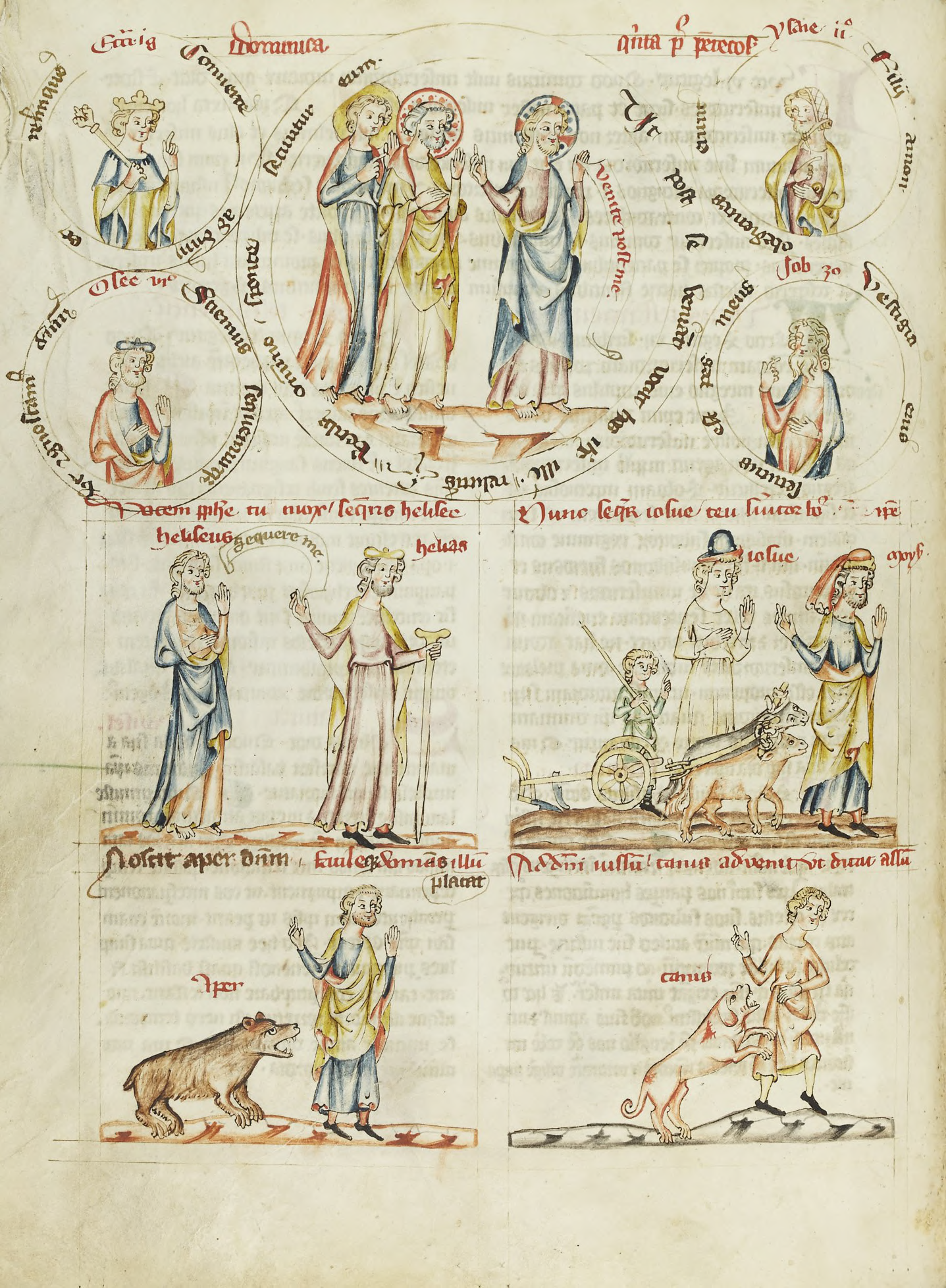
Fourth Sunday after Pentecost
By Udalricus Campiliensis († c. 1358)
(AI Translation)

On this Sunday it is read: That at the calling of the Lord, Peter, James, and John, leaving all things behind, followed Him. For the Lord calls some to follow Him through an inner inspiration. Others He summons by the extension of His hand. Others He draws through love. Others He drives through scourging. Hence: "On this day, if you hear the voice of the Lord, harden not your hearts &c"

For the faithful, together with the Apostles, follow the Lord:
In holy living: namely, in the world.
In joyful flight: namely, at the moment of death.
In the common resurrection of bodies: namely, in the future judgment.
In an abiding place of eternity: namely, in eternal joy.

For in order that anyone may be able to follow the Lord perfectly, it is necessary that he totally forsake and despise all things carnal, worldly, and earthly, and, denying himself, live as a pilgrim in this world.

Old Testament (Left)
In the nineteenth chapter of the Third Book of Kings, it is read that the prophet Elijah called Elisha, and immediately, leaving all things behind, he followed him. For just as Christ's disciples left all things at His calling, so Elisha, in following him, left all things for the ministry of Elijah.

By Elijah is understood Christ - the ascending Lord - who by holy promptings or other admonitions has called Elisha, that is, any righteous person whom He has invited by His grace to a holy conversion here, and to the sublimity of eternal glory in the future. Then, without any delay, He must be followed, not with sluggish steps, but with devout inclinations of obedience, so that our service may be pleasing to Him, through whom everlasting reward may be given to us.

Old Testament (Right)
In the twenty-seventh chapter of Numbers, it is written that Joshua followed Moses and ministered to him. For just as the Apostles cleaved to the Lord Jesus after He called them, so Joshua, cleaving to the calling of Moses, zealously ministered to him.

For Moses is interpreted as "drawn out of the water," and signifies Christ, who admonishes, attracts, and calls a person, now by benefits, now by ways of correction, until that person completely conforms and adapts himself to His will by ministering to Him. To this, let the devout prelate attend, who refines Elisha - which is interpreted as "salvation," that is, a subject seeking the salvation of his soul - now with persuasions, now with corrections, until he seeks nothing besides God, and following the Lord, may be saved with Him at the very last.

Nature (Left)
The Liber Rerum relates that the wild boar, although it is fierce, once tamed it readily and loyally follows its master.

By the boar, savage, brutish, unpolished, and wild men are signified, just as the Apostles were. These men although they are far off from the knowledge of divine truth, if only they are captured by the grace of God - that is, drawn by the magnitude of the light of faith, just like the excellent Apostles were - then, consequently, they can be most easily tamed to follow the Lord, to fulfill His every pleasure, and even to endure whatever adversities may occur, for with the grace of God they can mirror even the contrition of Peter, the patience of James, and the faith of John in tribulation.

Nature (Right)
Aristotle and Solinus say: That dogs, when called by their masters, immediately follow and recognize them.

Are not dogs, loyal to the utmost degree by nature, the Apostles - through whom the Lord performed many miracles, through whom many thousands of men approached Christ, through they were led to the revealed faith and even unto martyrdom? For dogs, at the calling of their Lord, that is, Christ, immediately submit themselves to the desires of their Master, and thus can do many great and wonderful things.

Hence, O Lord, we beg to be called by Your grace, so that we may be worthy to contemplate You in Your eternal beatitude.