Send CathInfo's owner Matthew a gift from his Amazon wish list:
https://www.amazon.com/hz/wishlist/ls/25M2B8RERL1UO

Author Topic: Moon shadow laser NONSENSE - Flat Earth confirmed  (Read 5763 times)

0 Members and 1 Guest are viewing this topic.

Offline Quo vadis Domine

  • Supporter
Re: Moon shadow laser NONSENSE - Flat Earth confirmed
« Reply #20 on: April 13, 2024, 07:55:14 AM »
I can't believe how they repeat a lie early and often, to try to convince us it's true.

"Lie big or go home!" is their philosophy. Most good people, who can't conceive of such satanic boldness, assume they CAN'T POSSIBLY be lying about something so fundamental -- that they would never lie that BIG.  ...Would they?

They would.

Look at the picture on the bottom. That is REALITY. You can do it yourself, at home, in a minute or two. Just get a light source, a ball of some kind, and a globe. Read 'em and weep.

I understand they can't prove gravity at small scale, or "molecules to man" evolution, or random chance creating information/new features in a creature, or pressurized air without a container, the motion of the earth, the curvature of the earth, etc. Most of the Globe Earth model they can't prove at all. They basically say "trust us!".

But THIS is merely the behavior of light, spheres, bodies, basic physics. This SHOULD be demonstrable at small scale. This should take up little space or materials, it should be very cheap and easy to demonstrate. They should be able to SHOW US this with actual, physical models and lights. Not a CGI cartoon where they could have anything happen -- why not have a basic, physical model set up to demonstrate this alleged behavior?

Nowhere in human experience or reality do 2 bodies and a light source cast pin-point focused shadows like this. As a matter of fact, the exact OPPOSITE happens. The shadow would spread out with increased distance. So the further the "earth" was behind the moon, the LARGER the moon's shadow cast on the earth would be.

This is all made-up nonsense to salvage the Globe model. People are SO trusting of authorities! They distrust their own senses, and trust some liars who have been proven to lie again, and again, and again. It's sad.

Matthew,

This may help you understand what actually happens during an eclipse:

https://www.timeanddate.com/eclipse/shadows.html


Umbra, Penumbra, and Antumbra: Why Are There 3 Shadows?

By Konstantin Bikos
On their journey through space, the Earth and the Moon cast 3 different shadows causing different types of solar and lunar eclipses. Why are there 3 shadows?
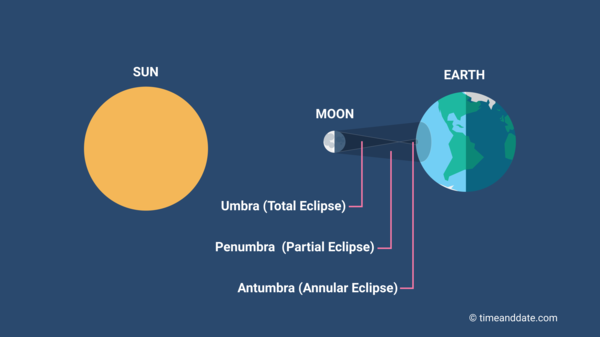
Illustration of the Moon's 3 shadows: umbra, penumbra, and antumbra.

Eclipse Type Depends on Shadow Type
If the Moon's shadow falls on Earth, we get to see a solar eclipse; the Earth's shadow falling on the Moon results in a lunar eclipse. However, there are different types of solar and lunar eclipses. A solar eclipse may be totalpartial, or annular; a lunar eclipse may be totalpartial, or penumbral.
The type of eclipse we experience depends on the type of shadow that is involved. Both the Moon and Earth cast 3 shadows:
The umbra is the shadow's dark center portion, while the penumbra and the antumbra are different types of half-shadows.
Shadow Experiments
To understand why the Earth and the Moon have 3 types of shadows, let's start on a smaller scale. The number and types of shadows created by an opaque object depend on its size in relation to the size of the light source. However, their absolute size is irrelevant, so a basketball illuminated by a large lamp produces the same shadows as the Moon illuminated by the Sun.
So imagine that you are in a windowless room with 1 light source and 1 round object that casts a shadow, say, a basketball. Both the light source and the basketball are at the same height as your head. You are standing on the side of the ball exactly opposite to the light source, facing it, so the order is: light source – basketball – you.
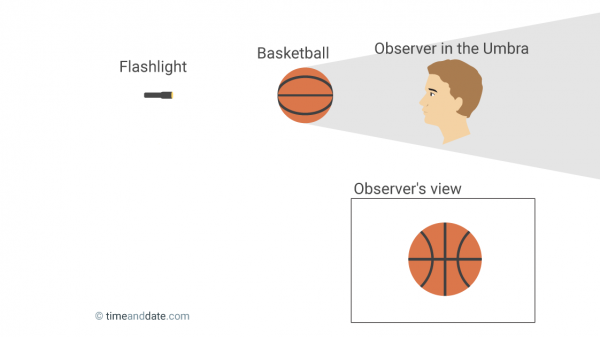
Illustration image

1st Experiment: Umbra Only
Rule: If the light emanates from a punctual light source, the object casts only 1 type of shadow: an umbra.
Let's say the light source is a tiny flashlight pointing into your direction. If you look into the direction of the lamp from behind the basketball, it is entirely invisible as the ball blocks the view and the light rays don't reach you. The ball's shadow is uniform, it only has an umbra.
If you move to the side, the flashlight immediately becomes visible as soon as you leave the shadow.
2nd Experiment: Umbra and Penumbra
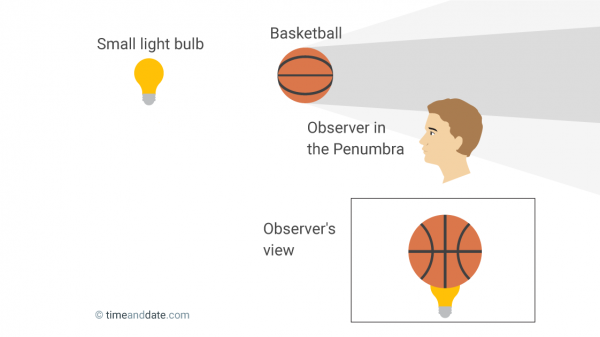
Illustration image

A light source with a larger surface area creates 2 shadows.


Rule: If the light source is not punctual but has a larger surface area, a 2nd type of shadow appears around the object's umbra: the penumbra.
Now the light source is a round lamp that is a little smaller in diameter than the basketball. If you line up with the lamp and the ball, no light is visible because you are within the ball's umbra. However, as you move to either side, part of the light source becomes visible. That's the penumbra.
If you move further to the side until you can see all of the lamp's surface, you have left the penumbra.
3rd Experiment: Umbra, Penumbra, and Antumbra
Illustration image

If the diameter of the light source exceeds that of the object, an antumbra appears.

Rule: If the diameter of the light source is larger than the diameter of the object, a 3rd type of shadow appears where the cone-shaped umbra ends: the antumbra.
In this experiment, the light source is another round lamp, but this time it has twice the ball's diameter. Imagine once more that you are looking at the lamp from behind the ball. As long as you are fairly close to it, the ball's apparent size exceeds the lamp's apparent size. You are within the umbra, and the lamp is invisible.
However, as you move away from the ball, its apparent size decreases. At some point, the basketball will appear smaller than the lamp. A ring of light will appear around the ball as the outer rim of the lamp comes into view. You have just entered the basketball's antumbra.
3 Shadows, 6 Types of Eclipses
Our solar system resembles the set-up of the last experiment. The Sun is a very large light source, its diameter exceeding that of both the Earth and the Moon. This means that, on their journey through space, both objects produce all 3 types of shadows.
Depending on which shadow type is involved, we can experience 3 different types of solar eclipses and 3 different types of lunar eclipses on Earth:
Umbra Eclipses
The umbral shadow can produce the following eclipses:
Penumbra Eclipses
The penumbral shadow is involved in these eclipses:
  • Partial solar eclipse – the Moon's penumbra falls on the Earth's surface, and the observer is within the penumbra.
  • Partial lunar eclipse – the Earth's penumbra covers the area of the Moon's visible surface that is not covered by the umbra.
  • Penumbral lunar eclipse – the penumbra covers all or part of the Moon, the umbra misses it.
Antumbra Eclipses
The antumbral shadow can only cause 1 type of eclipse:
  • Annular solar eclipse – the Moon's antumbra falls on the Earth's surface, and the observer is within the antumbra.


Offline Quo vadis Domine

  • Supporter
Re: Moon shadow laser NONSENSE - Flat Earth confirmed
« Reply #21 on: April 13, 2024, 08:25:15 AM »
Types of shadows:


Offline St Giles

  • Supporter
Re: Moon shadow laser NONSENSE - Flat Earth confirmed
« Reply #22 on: April 13, 2024, 09:02:55 AM »
No.  They are parallel for all intents and purposes, and insufficient to account for the degree of bend necessary to reduce totality to about 100-150 miles wide.
Prove it with math.

They are either parallel or they aren't. The earth is flat for all intents and purposes, so don't worry about driving off the road and getting stuck in a ditch.

The moon looks pretty small, why can't it cast a shadow as small as it looks? That's a valid question, though I'm not implying that it really does cast a shadow the size of a dime. Maybe it casts a shadow 70miles wide because it is only as big as a dime, and shadows, as you say, can only get bigger.


What makes you so sure you are right? Everyone thinks they are right about a lot of stuff that they are actually wrong about. How is it that people can reason through something and come up with differing and wrong conclusions? Don't put too much faith in your own judgments, and certainly not in the convincing yet deceiving pictures/demonstrations by others like what Matthew posted.

Offline Thed0ctor

  • Supporter
Re: Moon shadow laser NONSENSE - Flat Earth confirmed
« Reply #23 on: April 13, 2024, 12:33:10 PM »
Matthew,

This may help you understand what actually happens during an eclipse:

https://www.timeanddate.com/eclipse/shadows.html


Umbra, Penumbra, and Antumbra: Why Are There 3 Shadows?

By Konstantin Bikos
On their journey through space, the Earth and the Moon cast 3 different shadows causing different types of solar and lunar eclipses. Why are there 3 shadows?
Illustration of the Moon's 3 shadows: umbra, penumbra, and antumbra.

Eclipse Type Depends on Shadow Type
If the Moon's shadow falls on Earth, we get to see a solar eclipse; the Earth's shadow falling on the Moon results in a lunar eclipse. However, there are different types of solar and lunar eclipses. A solar eclipse may be total, partial, or annular; a lunar eclipse may be total, partial, or penumbral.
The type of eclipse we experience depends on the type of shadow that is involved. Both the Moon and Earth cast 3 shadows:
The umbra is the shadow's dark center portion, while the penumbra and the antumbra are different types of half-shadows.
Shadow Experiments
To understand why the Earth and the Moon have 3 types of shadows, let's start on a smaller scale. The number and types of shadows created by an opaque object depend on its size in relation to the size of the light source. However, their absolute size is irrelevant, so a basketball illuminated by a large lamp produces the same shadows as the Moon illuminated by the Sun.
So imagine that you are in a windowless room with 1 light source and 1 round object that casts a shadow, say, a basketball. Both the light source and the basketball are at the same height as your head. You are standing on the side of the ball exactly opposite to the light source, facing it, so the order is: light source – basketball – you.
Illustration image

1st Experiment: Umbra Only
Rule: If the light emanates from a punctual light source, the object casts only 1 type of shadow: an umbra.
Let's say the light source is a tiny flashlight pointing into your direction. If you look into the direction of the lamp from behind the basketball, it is entirely invisible as the ball blocks the view and the light rays don't reach you. The ball's shadow is uniform, it only has an umbra.
If you move to the side, the flashlight immediately becomes visible as soon as you leave the shadow.
2nd Experiment: Umbra and Penumbra
Illustration image

A light source with a larger surface area creates 2 shadows.


Rule: If the light source is not punctual but has a larger surface area, a 2nd type of shadow appears around the object's umbra: the penumbra.
Now the light source is a round lamp that is a little smaller in diameter than the basketball. If you line up with the lamp and the ball, no light is visible because you are within the ball's umbra. However, as you move to either side, part of the light source becomes visible. That's the penumbra.
If you move further to the side until you can see all of the lamp's surface, you have left the penumbra.
3rd Experiment: Umbra, Penumbra, and Antumbra
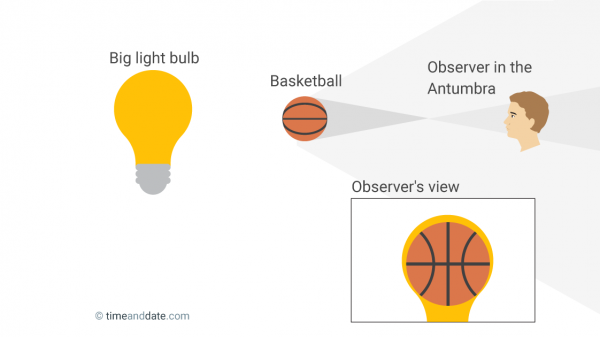
Illustration image

If the diameter of the light source exceeds that of the object, an antumbra appears.

Rule: If the diameter of the light source is larger than the diameter of the object, a 3rd type of shadow appears where the cone-shaped umbra ends: the antumbra.
In this experiment, the light source is another round lamp, but this time it has twice the ball's diameter. Imagine once more that you are looking at the lamp from behind the ball. As long as you are fairly close to it, the ball's apparent size exceeds the lamp's apparent size. You are within the umbra, and the lamp is invisible.
However, as you move away from the ball, its apparent size decreases. At some point, the basketball will appear smaller than the lamp. A ring of light will appear around the ball as the outer rim of the lamp comes into view. You have just entered the basketball's antumbra.
3 Shadows, 6 Types of Eclipses
Our solar system resembles the set-up of the last experiment. The Sun is a very large light source, its diameter exceeding that of both the Earth and the Moon. This means that, on their journey through space, both objects produce all 3 types of shadows.
Depending on which shadow type is involved, we can experience 3 different types of solar eclipses and 3 different types of lunar eclipses on Earth:
Umbra Eclipses
The umbral shadow can produce the following eclipses:
Penumbra Eclipses
The penumbral shadow is involved in these eclipses:
  • Partial solar eclipse – the Moon's penumbra falls on the Earth's surface, and the observer is within the penumbra.
  • Partial lunar eclipse – the Earth's penumbra covers the area of the Moon's visible surface that is not covered by the umbra.
  • Penumbral lunar eclipse – the penumbra covers all or part of the Moon, the umbra misses it.
Antumbra Eclipses
The antumbral shadow can only cause 1 type of eclipse:
  • Annular solar eclipse – the Moon's antumbra falls on the Earth's surface, and the observer is within the antumbra.
These illustrations are helpful up until the bigger light source one. That one doesn't make sense to me honestly. The first two show two shadows, both bigger than the object but then the third shows the Umbra shrinking? You've also shared other photos where the two shadows grow but not one where they shrink could you show a live example where the light source is bigger and we see the shrinking of the shadow?

I also find the image where there's a giant boulder on the earth compelling. It looks like what the NASA photos of being on the moon look like but contradict the "luminous" aspect of the moon that we see on earth. If the moon is super luminous from the earth it seems intuitive that the photos NASA shows of the astronaut on the moon would also reflect a brilliant light. It would be really hard to get a photo that didn't look overexposed or something. 

Offline Ladislaus

  • Supporter
Re: Moon shadow laser NONSENSE - Flat Earth confirmed
« Reply #24 on: April 13, 2024, 12:36:09 PM »
You'll notice how all the illustratons rely on the deception of making the sun look 5-10 times larger than the earth, which is not the case given the distances involved.  Then they even have to make the lightbulb super giant sized to pull it off.  :laugh1:

It's ridiculous and it's deception, but the resident dupes fall for anything that NASA and the scientific establishment feed to them.  CAD models completely debunk the nonsense falsely depicted in the NASA cartoons.  Bottom line for these clowns here is that they've already made up their minds beforehand that the modern narrative regarding the cosmos is true and they'll accept anything that they think might even sound remotely plausible as "proof".