.
.
Lightening in the clouds!
Author's analysis and FAQs answered: https://randomphotons.com/alone
.
.
Go to the FAQs answered page and see the author's description of the source.
He composed the video by a 3-step process, beginning with the time exposures shot on the ISS.
This is not the same camera that the ISS live feed uses, which has set exposure parameters that can't be changed.
.
He has topics beginning with these:
.
.
Is this CGI?All the sequences in the video are real photographs taken with a decent stills camera (typically a Nikon) with long exposure time. The only thing special about them is they are taken from a space station orbiting the Earth.
.
.Why don’t the clouds move?Since this is a time-lapse, one might expect to see the clouds moving throughout the video. After all, we can see clouds moving from Earth in real time.
However, the ISS is a lot further away from the cloud layer than we are, and that distance changes how much movement is visible.
cuмulonimbus, or storm clouds, are at most 13 km above us. The ISS is between 409 km and 416 km above us, so let’s say it is 400 km away from the cloud layer. (31 times further away from ISS)
Let’s imagine we are taking two square photos of the same clouds at the same moment in time with the same type of camera - one from earth looking straight up, the other from the ISS directly above it looking straight down.
This will give us two pyramids, with the point being the camera, and the base being the cloud layer. Something like this: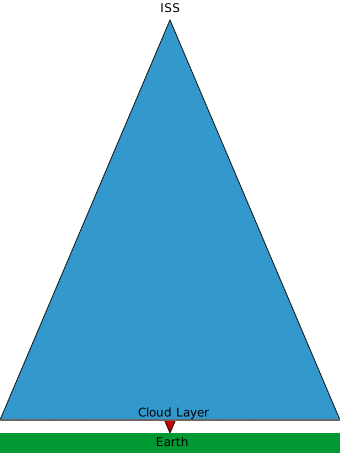 (The tiny red triangle is your view from Earth.)Credit: David PetersonIf we calculate the dimensions of the bases, we can determine how much cloud area each photo will cover.A typical 50 mm lens on a 35 mm sensor will have a field of view of about 46°. If we divide the pyramid in two we get two right-angled triangles, so we can use some Pythagorean geometry to calculate the area of the base. Here is the formula:
(tan(26) x h x 2)2 = area of the base
When we plug in 13 km for the Earth-bound photo, we get an area of 122 km2, or an 11 km x 11 km square.From the ISS at 400 km, we get an area of 115,315 km2, or 340 km x 340 km of visible clouds.That gives us a ratio of 967:1 between the areas covered by the two photos. Here is what that would look like: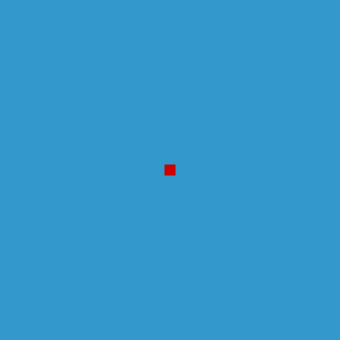 Credit: David Peterson
The blue is the area covered by the photo from the ISS. The red is the area covered by the photo from Earth. You will understandably lose a lot of detail.
Not only that, but given the speed of the ISS, a full orbit takes 90 minutes travelling at 7.66 km/s. As such it would take only 44 seconds for something to appear on one edge of the photo and disappear off the other edge.
All those things combined mean you don’t see much change in clouds from the ISS.
..If all this is not immediately comprehensible, don't feel like you're alone.
You have to remember the scale difference, including how close we are to the clouds above us.
Our instinct is to naturally think how FAR above us the clouds are, and this new recognition of how CLOSE we are compared to how FAR above the clouds the ISS is, requires an outlook that we are not accustomed to having in mind.
It is necessary to use your sense of scale to step outside the close-knit world of earthly bound views, to recognize how different the view of earth's cloud structure from the ISS is.
Clouds viewed at close range have one appearance, but the SAME clouds viewed from a place with 967 times less detail because it's 31 times further away, necessarily appear to be completely different clouds. And in order to notice the same cloud movement at the more distant location that we see from earth, you would need to use a 31-power magnification. Any movement of the camera would destroy the clarity of the time exposure. It would require a LOT more sophistication in the camera mount, since there are small vibrations happening all the time on the ISS due to various activities inside going on.

 Topic: 50 Plus Reasons The Earth Is Not Flat (Read 335944 times)