.
Peterson's FAQ page has loads of information.
https://randomphotons.com/alone.
Can you really see curvature from the ISS?.
The ISS’s altitude isn’t high enough to see the full curve of the earth. However, it can see a reasonably large segment of the earth, enough to see a curve on that segment. Here are some scale diagrams to help illustrate it:
Firstly, here is a scale diagram of the earth and the ISS (click to zoom in):
.Credit: David Peterson & Andrew Peterson
.
The red line is the visible horizon from the ISS at an altitude of 400 km. [The red line segment represents a circle as it appears when viewed from the side.]
Next, here is an overhead view, looking down towards the ISS, with the red circle being the visible horizon from the ISS:
[Note: the black feature "Flat Horizon" is not what a viewer sees from the ISS but what a viewer WOULD see if the horizon were flat. It is included here for a frame of reference to distinguish it from the reality that is observed in fact. IF this "Flat Horizon" were to be shown in the diagram ABOVE, it would have appeared as a single dot at the point at the top of the red line segment, where it intersects the earth's radius line dimensioned, "6367 km." ]
.
.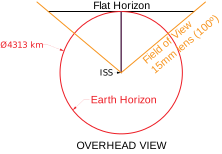 Credit: David Peterson & Andrew Peterson .
The red circle is the horizon, the same as the red line in the first diagram, looking down from 90º. The black “Flat Horizon” is a tangent to the Earth’s horizon, and is what would be visible as a straight line when looking at the horizon from the ISS [what would be visible but it is in fact not visible from the ISS since it does not exist in reality -- it only exists in the imagination of those who desire it to exist]. The orange lines indicate a field of view of 100º when using a 15 mm lens on a 35mm sensor, as was the case for most of these sequences.
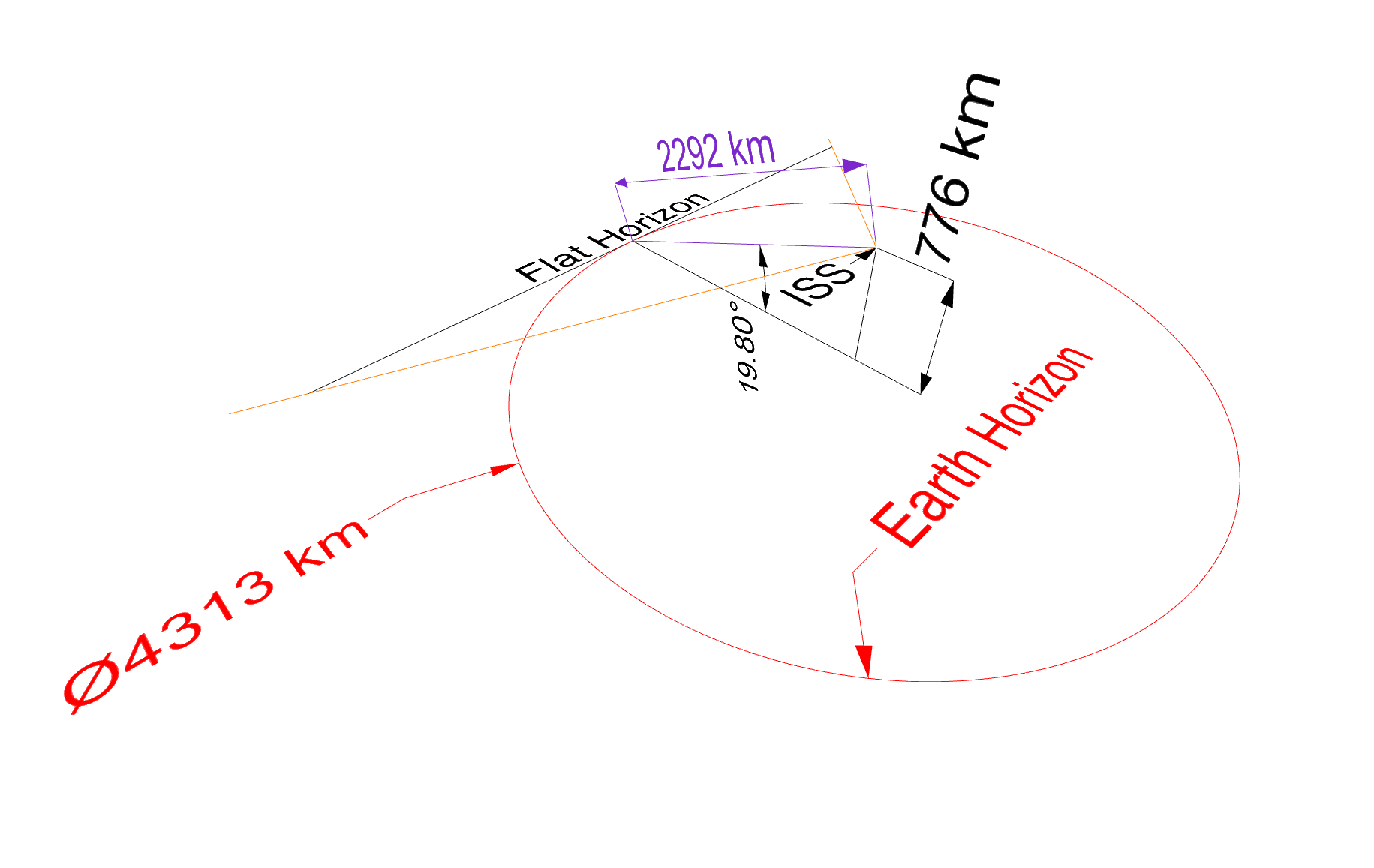
Here are the same details, from an off-centre perspective:
[The "Flat Horizon" only appears here as it would appear when the viewer is looking in that direction. If the viewer were looking in some other direction, the "Flat Horizon" would have to be re-drawn to be tangent to earth and in front of that other line of sight, wherever it is. What a viewer actually sees from the ISS is the red "Earth Horizon" which is rendered in red so as to stand out and be noticed here.]
.
Credit: David Peterson & Andrew Peterson
.And here is the view you get from the ISS, looking directly at the horizon, with a field of view of 100º, which is what is present on a 15 mm lens [What you do in fact see is the red curving horizon. What you do not see is the flat, black horizon, which is drawn in here for the sake of comparison only, because it is not actually visible in reality.]
:..
And an actual photo from the ISS, taken with a 15 mm lens on a Nikon D3S, for comparison:
[Note: the "Flat Horizon" is not shown because it is not visible, because it does not exist. It was drawn in above as a reference for what it WOULD look like if it WERE visible, but since it is not there, it is not visible in fact. The thin green haze is the earth's atmosphere above the horizon -- the atmosphere has its own horizon at its outer limits, and what is on the other side of that also shows up appearing to thicken the foreground atmosphere even though it is in the background behind the horizon.]
.

 Topic: 50 Plus Reasons The Earth Is Not Flat (Read 335298 times)