Bishop Tissier de Mallerais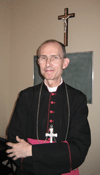 Remnant Editor's Note: Due to the controversial nature of some comments made in this interview, we have decided to open up a small readers' forum at the conclusion of the interview. Comments should be sent to editor@RemnantNewspaper.com. MJM (32 Responses)
Interviewer’s Note: I had met His Lordship Bishop Bernard Tissier de Mallerais of the Society of St. Pius X on only one occasion previously. It was the 1997 ordination of Fr. Frank Kurtz, after which I had the chance to ask His Lordship some questions. I was struck by his courtesy and gentleness, especially as I had just seen him celebrate Mass in one of the most precise and holy ways I had ever seen. Recently, I expressed a desire to Michael Matt to interview His Lordship for The Remnant. Mr. Matt allowed me to “track him down” and line up an interview while the Bishop was here in Colton for Confirmations. The interview was recorded in person and took approximately 45 minutes. The text below has been vetted by His Lordship for textual and factual accuracy. Before being published here in The Remnant, the text was approved and signed off on by His Lordship. (Please note that I use and prefer “Your Lordship” to the more contemporary “Your Excellency” when referring to a Bishop.) SH
Stephen Heiner: My Lord, Zenit.org released a text on 7 April from the French episcopate on the occasion of the end of their plenary assembly which included the following statements: “Truth implies being clear on our points of dissension. These points include acceptance of the Magisterium more than questions of liturgy, in particular, that of the Second Vatican Council and of Popes of the last decades. Communion may be accompanied by questions, requests for precision or further reflection. It cannot tolerate a systematic rejection of the council, criticism of its teaching, or denigration of the liturgical reform decreed by the council.” Furthermore, AngelQueen.org recently released an “exclusive interview” with Bishop Rifan from the diocese of Campos. Within the text of the interview, His Lordship states (through a subordinate) that essentially so-called “practical, effective” communion within the Roman Rite is demonstrated by concelebration in the Novus Ordo, citing canon 751. How do you as a Roman Rite bishop, who recognizes the valid election of Benedict XVI, respond to these comments?
His Lordship: Firstly, I am not familiar with this text. I do not know it. It is not interesting to me as I do not follow such news. That is not the problem here. The problem is not “communion.” That is the stupid idea of these bishops since Vatican II – there is not a problem of communion, there is a problem of the profession of faith. “Communion” is nothing, it is an invention of the Second Vatican Council. The essential thing is that these people (the bishops) do not have the Catholic Faith. “Communion” does not mean anything to me – it is a slogan of the new Church. The definition of the new Church is “communion” but it was never the definition of the Catholic Church. I can only give you the definition of the Church as it has been understood traditionally.
SH: And what is that, My Lord?
HL: The Church is a visible society, of those who are baptized, profess the Catholic faith, and submit to the Roman Pontiff. These three elements are essential and necessary – so that is all that matters to me – “communion” means nothing to me. If I had something important to tell you it is that these people have lost the Faith – especially faith in the mystery and dogma of the Redemption. Because, you know, the Second Vatican Council did not say a single thing about Redemption. The liturgical reform, yes, it falsified completely the mystery of redemption.
SH: Well, this Council, of course, was something that the Holy Father worked closely on as a theologian. You were acquainted with him when he was Cardinal Ratzinger in 1988 and I know that you dealt with him closely regarding the “negotiations” at the time. You’ve had the chance to observe him over a year (it has just been a few days since the anniversary of his election). Has there been a change in his words, actions, or tone since he has become the Holy Father?
HL: I knew him as a negotiator, who wanted to reconcile us, to reintroduce us into the Conciliar Church. He was thus to me, a man of intelligence, interested in the project of “re-integration.” We avoided his initiatives. But now he is the Pope and he has special graces, but he doesn’t use those graces because he does not do anything for the Church. It has been a year now, and he has done nothing!
SH: It has been said that he feels a certain guilt about 1988, because externally he appeared to be “fighting for” the Society. Do you feel this is true?
HL: He was honestly persuaded that we were outside the Church and that he had the duty to re-introduce us to the Church. This is of course, ridiculous, because we are not outside the Church. We never have been. This was a great desire for him (reconciliation). This was some months before my consecration to Bishop. But now he is the Pope! He should do something for the Church! But he does nothing!
SH: So you have seen nothing concrete that he has done, My Lord?
HL: No, nothing.
SH: In the recent consistory he increased the voting power of Europe at the expense of the other parts of the Church. It is said that he wants Europe to again take the reins of leadership for the Church. But Europe is infected with the rise of Islam. In the wake of the recent riots and a February excerpt in DICI website regarding the rise of Islam in Europe, what is the state of the Church in Europe? Is Europe prepared to take the reins, so to speak?
HL: This is not a question regarding Benedict XVI; this is a question of the governments in Europe allowing Islam to grow unchecked. The French government, for example, practically invites these Muslims to France. The government wants to control their religion, so they make regulations and laws in order to control it. The bishops do not see this danger – well, they are contradictory. On one side they see the danger and they do not want to give them (the Muslims) the churches (to be used as mosques). And on the other hand, they say that Christians and Muslims must reconcile – that there is no difference between the religion of Christians and Muslims, and that Islam is a very “tolerant” religion. So, they are completely contradictory with themselves.
SH: You would say that this is the attitude of the bishops in Germany, France, Switzerland—there is no difference?
HL: Yes, absolutely no difference. They are completely contradictory. They see the danger – because they will be obliged (under French law regarding public buildings) to give empty churches to the Muslims. But then they say that Islam is very good, and tolerant.
SH: Well, then, Benedict’s “European project” has many obstacles. You said that you saw him as a negotiator. Bishop Fellay recently said that he is very closely tied up with the Council. What are the main ideas that this Holy Father holds that are at odds with Tradition?
HL: Collegiality, for instance. He wants to rule the Church with the bishops, with the cardinals. He becomes unable to rule the Church. This is evident because he has been the Pope for one year and he has done nothing! Collegiality paralyzes him. Voila – yes, collegiality paralyzes the Pope.
SH: And he is willing to be paralyzed?
HL: Yes, he believes it (in collegiality)!
SH: Regarding ecuмenism, it is said that he was not happy about Assisi…
HL: Ecuмenism is another thing; yes, it was said that he despised Assisi, but we are not sure, and now he has gone into the ѕуηαgσgυє many times, with the Jєωs, so, it is not clear…because he has an inclination towards the Jєωιѕн religion.
SH: Did he not reduce the independence of the Franciscans at the Basilica (of Assisi)?
HL: Yes, but this is not a major matter.
SH: When I was on the phone with Bishop Fellay to clarify a quote from his conference in Denver, I had transcribed (I did not tape the event) that “He (Benedict) believes that the secular state is the preferred mode of existence within the Catholic view of social organization.” Bishop Fellay corrected me by saying “it is the only mode of existence.” Are these not always the “big three” topics? That is to say, collegiality, ecuмenism, religious liberty? Is he not completely committed to these ideas?
HL: Yes, he is committed to these three errors. Regarding religious liberty he is almost exactly like John Paul II. They are convinced that no government can be Catholic, that no government can acknowledge Jesus Christ as true God. This is, of course, contrary to Catholic teaching, specifically the teaching of Pope Pius XI, in Quas Primas.
SH: Yes, and the Syllabus…
HL: Yes, but the Syllabus was in the 1860s and Quas Primas was in 1925, so it is not so old – so outdated, as they would like to say.
SH: Well, I have some more personal questions for you. I recently read your work on the Archbishop. You knew him so well. Were there any surprises for you in writing and researching this work?
HL: My great surprise was the great affection and respect that all these progressive fathers had for him – even if they did not agree with him – it was amazing. They respected him so much for his Christian, his Catholic personality. All of them testified to this when I met them – this – they loved him, even though they did not understand him. Because, truly, they could not reconcile the gentleness, the charity, the frankness, and yet, on the other hand, his strength in the Faith. They could not reconcile this.
SH: If they saw His Grace’s Christian personality, how did they not see his Christian conclusions?
HL: Because they were liberal, hence they could not understand that a man could be so kind and yet so strong at the same time.
SH: You are coming up on your 18th anniversary of consecration. What have been your thoughts about the episcopate? That is to say, what did you not expect in June of 1988?
HL: My great surprise is that the crisis in the Church has been so long. We had prayed that the good Lord would send us a truly Catholic Pope, a holy Catholic Pope, just a few years after my consecration, and here we are, 19 years, and it is the same. It is a great disappointment. The crisis lags, and we have to continue to fight. That is the great difficulty – not for me, but for the faithful especially. The faithful have to be heartened, they must be encouraged not to be fatigued, to be tired. We must continue to fight.
SH: So in your role as a bishop you must travel all around the world to see the faithful. What is a common link between the traditionalist faithful?
HL: I think it is the great esteem for large Catholic families – that is common. The grace of Christian marriage and the desire to have many children – they understand that the future of the Church and the future of their homeland revolve around a fruitful marriage. And that is the grace of Archbishop Lefebvre – that, and the Holy Mass. That is what he preached.
SH: My Lord, the General Chapter of the Society is this summer…
HL: Ah, yes.
SH: There is some confusion among the faithful as to whether someone who has been the General Superior may be elected again. For example, Fr. Schmidberger has been Superior General – can he be so again?
HL: Yes, there is no limitation.
SH: Yes, Fr. Schmidberger was Superior General after you were consecrated, so you, as a bishop, had to report to a priest. I think the feeling among the faithful was, that once Bishop Fellay was elected, that a bishop would continue on in that position, as opposed to a simple priest. Is this true? Well, let me be more specific without asking you for a prediction. Is it likely that the situation of having a bishop as Superior General will continue?
HL: No, it is not normal. Actually, the most normal thing would be for a simple priest to be Superior General.
SH: Why do you say that, My Lord?
HL: Because it is in our constitutions, and because the existence of bishops within our Society is something extraordinary – not foreseen. It is not normal – so I think it would be very normal for a simple priest to be Superior General, and I would be ready to obey, to submit, to him.
SH: So it is an extraordinary situation for the Society to have bishops, but you can accommodate yourself to the idea of reporting to a priest – well, obviously you did so with Fr. Schmidberger. Let me ask you to clarify this: the constitutions do not prevent a previous Superior General from being re-elected?
HL: No.
SH: So Bishop Fellay could be re-elected.
HL: Yes.
SH: There are always troublemakers, especially on the Internet, who quote so-called anonymous “inside sources” who often know really nothing, and who seem to seek to splinter the Society by talking about a so-called “schism within the Society” if and when Bishop Fellay were to make a “deal” with Rome. My question is this: when Bishop Fellay speaks, or makes a statement, does he so “on behalf of the bishops” of the Society?
HL: No. I would say he speaks as the Superior General of the Society. Simply that.
SH: So, as bishops your primary role is…
HL: To give Confirmations and do Ordinations, simply. That is the role that Archbishop Lefebvre gave us. So we have no “leading role” in the Society, per se, we simply submit to the Superior General.
SH: So, if there were to be a restoration within the Church, the bishops within the Society would not be necessary?
HL: If there were Catholic bishops in Catholic seats, no, we would not be necessary.
SH: My Lord, The Angelus recently reprinted a study by Fr. Pierre-Marie, O.P. which postulated that the new rite of consecration for bishops was valid – something which has been under some discussion of late since the Holy Father is the first pope to have been consecrated a bishop in the New Rite. There are, circulating on the Internet, statements that the Archbishop doubted the validity of the new rites of episcopal consecration…
HL: No, no, no. He never discussed the matter, never. No, no.
SH: So there has never been a question in the Society about the validity of any of the new sacraments?
HL: Archbishop Lefebvre never discussed the validity of episcopal consecrations.
SH: No, not about the episcopacy?
HL: I do not know his mind on this subject. The New Rite regarding episcopacy, he did not know it. He did not study these matters – or read it. Because, simply, he continued with the Old Rite.
SH: I think I have one more question: where is the Society growing the fastest in the world?
HL: The essential thing is that we re-establish Catholic families, Catholic schools, these are the great means of the growth of the Catholic Church. Indeed, many of our priests come from our schools. We insist to our faithful that they send their children to Catholic schools.
SH: Well, that’s all my questions, my lord. Now, when I type this I want to make sure all my quotes are accurate, so I will send you a transcript before you go to Veneta…
HL: No, no, these questions, you have not addressed the essential things – I appreciate your questions but you did not touch anything essential in your questions.
SH: What more, My Lord?
HL: Well, for instance, that this Pope has professed heresies in the past! He has professed heresies! I do not know whether he still does.
SH: When you say “has professed,” do you mean he still does?
HL: No, but he has never retracted his errors.
SH: But My Lord, if he has not retracted them, does he not still retain them? Of what are you speaking? Can you be more specific? I must admit I am no theologian and I have not read any of his works. Was this when he was a cardinal?
HL: It was when he was a priest. When he was a theologian, he professed heresies, he published a book full of heresies.
SH: My Lord, I need you to be more specific, so we can examine the matter.
HL: Yes, sure. He has a book called Introduction to Christianity, it was in 1968. It is a book full of heresies. Especially the negation of the dogma of the Redemption.
SH: In what sense, My Lord?
HL: He says that Christ did not satisfy for our sins, did not – atone – He, Jesus Christ, on the Cross, did not make satisfaction for our sins. This book denies Christ’s atonement of sins.
SH: Ah, I’m not sure I understand…
HL: He denies the necessity of satisfaction.
SH: This sounds like Luther.
HL: No, it goes much further than Luther. Luther admits the sacrifice…the satisfaction of Christ. It is worse than Luther, much worse.
SH: My Lord, I must return to the beginning of this line of questioning: are you saying he is a heretic?
HL: No. But he has never retracted these statements.
SH: Well, then, what would you say, My Lord, that it was “suspicious,” “questionable,” “favoring heresy”?
HL: No, it is clear. I can quote him. He rejects “an extremely rudimentary presentation of the theology of satisfaction (seen as) a mechanism of an injured and reestablished right. It would be the manner with which the justice of God, infinitely offended, would have been reconciled anew by an infinite satisfaction…some texts of devotion seem to suggest that the Christian faith in the Cross understands God as a God whose inexorable justice required a human sacrifice, the sacrifice of his own Son. And we flee with horror from a justice, the dark anger of which removes any credibility from the message of love” (translated from the German version, pages 232-233).
SH: What other heresies, My Lord?
HL: Many others. Many others. He has put up doubts regarding the divinity of Christ, regarding the dogma of the Incarnation…
SH: This cannot be true…
HL: It is very true. He re-reads, re-interprets all the dogmas of the Church. This is it. This is what he calls the “hermeneutic” in his discourse of 22 December 2005.
SH: This hermeneutic is also known as the “living tradition…” It would interpret existing doctrines in new lights…
HL: Yes, exactly. According to the new philosophy, the idealist philosophy of Kant.
SH: These are very strong words, My Lord, but yet, the Society is not sedevacantist…
HL: No, no, no, no. He is the Pope…
SH: But these are strong words…
HL: Ecclesia supplet. The Church supplies. It is even in the code of canon law: “in case of doubt, the Church supplies the executive power.” He is the Pope. Ecclesia Supplet. But we must know he has professed heresies.
SH: My Lord…has there been such a dark time in Church history?
HL: That is difficult to say. I would not say such a thing. It is sufficient to say that he has professed heresies.
SH: My Lord, I must emphasize that the paper I am writing for has wide circulation in the English speaking world…are these the words you wish to use?
HL: Yes. Yes. I have read Joseph Ratzinger, and have read his books. I can assure you that it is true.
SH: Well, then I’d like to know what was the Archbishop’s opinion of him when he was Cardinal Ratzinger?
HL: He did not read him. He never read him. He saw him as a man of negotiation. An intelligent, honest man, with dangerous initiatives regarding us.
SH: This line of discussion which you have introduced, My Lord, leads us back to the 1988 Protocol. One of the points there is that the Society would interpret the Council “in the light of Tradition.” Is that still the case today?
HL: Absolutely not. Not any more.
SH: So then what would be said, that the Council needs to be revisited, revised entirely?
HL: No, we would read the Council in the light of the “new philosophy.” Yes, that is the real “light” [chuckles]. That is the only “light” by which you can read it.
SH: So you would say the Society reads the Council in the light of the “new philosophy.”
HL: Exactly.
SH: And hence rejects it?
HL: That is the only way it can be read. You cannot read Vatican II as a Catholic work. It is based on the philosophy of Immanuel Kant.
SH: Idealism?
HL: Exactly, German idealism.
SH: So if you say that the proper way to interpret the Council is in the light of the “new philosophy,” how must the Church deal with this Council?
HL: I will say, one day the Church should erase this Council. She will not speak of it anymore. She must forget it. The Church will be wise if she forgets this council.
SH: Let me read it back to you from my notes. “The Church must erase this Council, not speak of it, forget it.”
HL: Forget it, yes. As a blank – tabula rasa. Ah, you must excuse me, Stephen, I must go hear confessions before Mass. Please excuse me.
SH: My lord, it has been a great pleasure, and both interesting and surprising.
HL: Likewise. It has been a pleasure.
So there it is. These are some of the strongest words I have ever seen from a bishop of the Society of St. Pius X. No further commentary beyond the fact that Bishop Tissier was very calm and clear as he spoke, and I thought it was interesting that he stopped me from ending the interview because he felt I had not asked some important questions. I’m grateful for the opportunity that Michael Matt gave me in pursuing this interview for The Remnant.
Stephen Heiner is the editor of TrueRestoration.com. He currently resides in Anaheim, California but will be moving to St. Marys, Kansas, this June. |


 Topic: Eleison Comments - Vigilant Bishop (no. 904) (Read 3942 times)