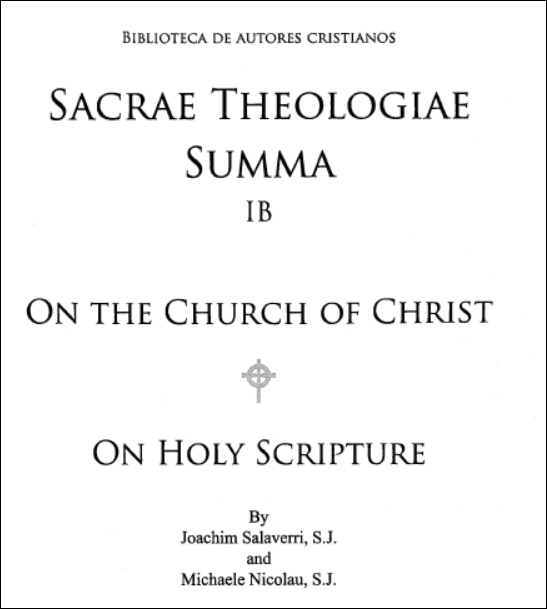
Notice that the Salaverri says "formal and manifest heretics ... have broken the social bond of faith and government established by Christ. By severing the social bond of government, they have cut themselves off from "the framework of the Church" and hence are no longer part of the Church's body.
Here is how Salaverri defines a public heretic four pages earlier:
No one who remains within the framework of the Church (i.e., has not severed the social bond of government) is a "public heretic," or a "formal and manifest heretic," according to the teaching of the theologian that you cited as your authority.
LaCosaNostra, Salaverri does not state "and government". Read it again. He states "or government". By the term "government", he is referencing "schismatics". It is true, however, that Salaverri defines "public heretic" as per your quotation. However, Salaverri also defines "private heretic":

Just prior to this, he defines and distinguishes between "manifest heretic" and "occult heretic":

Therefore, in what I provided in my earlier post (see screenshot below), Salaverri clearly means to include both "public manifest heretic" (i.e., a Catholic that openly leaves the Church by joining a heretical sect) AND "private manifest heretic" (i.e., a Catholic that does not openly leave the Catholic Church but shows his heresy outwardly) in his use of the term "heretic" in his thesis that "heretics are not members of the Church".
Note further that in the screenshot below, Salaverri does NOT use the term "public" or "private". He simply use the terms "formal" and "manifest" to describe "heretic". Therefore, it is beyond doubt that he is referencing BOTH "public" and "private" heretics.


 Topic: R&R -- why don't you get behind Father Chazal's sede-impoundism? (Read 56369 times)