This is an interesting text about the persecution of Padre Pio:
https://nonpossumus--vcr-blogspot-com.translate.goog/2018/10/alessandro-gnocchi-padre-pio.html?_x_tr_sch=http&_x_tr_sl=auto&_x_tr_tl=en&_x_tr_hl=enOriginal post in Spanish:
https://nonpossumus-vcr.blogspot.com/2018/10/alessandro-gnocchi-padre-pio.htmlThe below is a Google machine translation.
ALESSANDRO GNOCCHI: FATHER PIO CRUCIFIED BY THE CHURCH OF THE ANTICHRISTS (INFERNAL NOVEL)FOUNTAIN
The bomb arrived by mail a few months ago. No one was alarmed because it was contained in 176 pages printed in A4 format with a title that was reassuring even for those in my household, who also know how explosive the subject of Padre Pio can be . They took it for one of the many manuscripts I receive with the promise of sensational revelations and the kind request to find the editor interested in the scoop. But under an apparently harmless title, the cover bore the inscription “Geneve AID 1963”, which means “Geneva, International Association for the Defense of the Person and Works of Padre Pio of Pietrelcina, 1963”. In other words, 176 pages of pure plastic, the first Italian translation of the unattainable White Book that Emanuele Brunatto, president of the association for the defense of Padre Pio, had prepared to denounce the second persecution of the Capuchin saint and obtain his release. A bomb, in short. In the letter attached to the docuмent, the monk who sent it to me tells me: " Brunatto had threatened the publication of this "White Book" to bishops and cardinals and, in fact, the persecution of Padre Pio ceased because of this threat. Everyone knows this "White Book", but no one has ever read it, either because it is unattainable or because it is explosive. The few copies that remain are in French. This is the first translation into Italian, as far as I know. Certainly, the publication is reckless (...) it is true that fifty years have passed and all the people mentioned here are dead, but in reality the curtain rises on a scene that is not very edifying indeed. (...) Certainly this docuмent must be known by those who want to study Padre Pio or who love him anyway."
SUSPICIOUS DEATH OF A PUBLICAN . The name of Emanuele Brunatto, who liked to call himself "the publican" for his crazy life before his conversion and for the intemperance he did not always know how to resist afterwards, is little known even to many connoisseurs of the biographies of Padre Pio. However, he was the first spiritual son of the Capuchin saint, before whom he converted at the age of 28 in 1920. He lived for a long time in the convent of San Giovanni Rotondo, in cell number 6, next to cell number 5 of the saint, serving at his mass every morning and sitting in the choir at his side. And he was, above all, the most effective and tireless defender of the Father during the two persecutions suffered at the behest of the Church.
Very little, if any, has been said about the "publican", especially in the official books. It has been said that avoiding evoking his figure, because of his life and the energetic methods with which he knew how to move in case of need, would have helped the rehabilitation and the process of canonization of Padre Pio. The idea that in order to prove the sanctity of a Christian, it is necessary to keep silent so much of the truth about his life is not really honorable. But in reality, for the good sons of the Holy Roman Church, the problem is another: evoking Emanuele Brunatto means recounting what was brought to light by the man whom Padre Pio called "the Policeman" for his investigative ability: an infernal sequence of vicissitudes, misdeeds, betrayals of faith and morality at every station of the painful road that leads from San Giovanni Rotondo to the heart of Christianity.
And perhaps it also means remembering that his death, which occurred between 9 and 10 February 1965, hastily classified as the result of heart failure, leaves more than one doubt. " Something, and perhaps more than something, doesn't fit ," says Alberindo Grimani, a devoted scholar of Padre Pio and current director of the Emanuele Brunatto Archive . Grimani, as he has done many times publicly, tells me that the reconstruction of the “publican’s” daughter’s account is very different from the official one: “The study was in disarray. The large glass cabinet containing Brunatto’s vast docuмentation was open and the material, what was left, was scattered on the floor or on the old desk. It has been said that Emanuele died on the night of 9-10 February. But, from what was learned, in the following days, it seems that between 8:20 and 8:30 on the morning of the 10th he received a telephone call from a family member and that the two talked for a couple of minutes, or perhaps longer. That person wanted to come and see him, but he dissuaded her by saying: “No, it will be another time.” The tone of his voice indicated that he was a little nervous. Was he waiting for someone or was there already someone in the room? A friend confided to his wife Yvonne, who had remained in Paris, that he had proof that Emanuele had been killed with arsenic, having had a glass from the study analysed without the investigators noticing. Perhaps it is a coincidence, but on the morning of that 10th February Brunatto had an appointment with his friend Luigi Peroni, director of the Padre Pio Prayer Groups and biographer of the saint, to give him some of the docuмentation collected during his final investigations so that it could be kept safe. Peroni arrived when the police were already at the house.
Giuseppe Pagnossin, another devotee of the saint, wrote in the book Il calvario di padre Pio (The Calvary of Padre Pio) that on February 7 he received a phone call in the presence of witnesses in which Emanuele told him that he was frightened: " I am very worried and desolate; I am abandoning the cause, since the Capuchins want my skin ."
A phone call of the same nature and content was also received in San Giovanni Rotondo by Francesco Morcaldi, the man who from the beginning was at Brunatto's side in the battle to defend the Father.
CHAIN REACTION . The White Book , a summary of the docuмents that Brunatto had collected during decades of research and that had been duly protected, was now on my desk, translated into beautiful Italian with the harmless title Padre Pio . The content, knowing how to read it and knowing a little of the recent history of the church, and especially of its backroom, is really a bomb, but one that serves to trigger a chain reaction with the explosion of even more powerful devices. Its argument is based on the continuous allusion to facts and characters that Brunatto had explicitly staged with dates, circuмstances, names and surnames in two previous publications, Letter to the Church , printed in 1929 and signed by Francesco Morcaldi, and The Antichrists in the Church of Christ , printed in 1933 and signed under the pseudonym of John Willoughby. Two books with a strange destiny, written to secure the release of Padre Pio from the prison to which he was condemned, much feared by the poor friar's jailers, but never having reached the bookstores and today unreachable. Almost impossible to find, to be more precise. And even more radical with respect to that already great one of saving the true Mass, as I recalled about ten years ago, when I was writing with Mario Palmaro The Last Mass of Padre Pio . Today, I think I can say that the defense of the Divine Sacrifice was only the extreme result of a mandate given by Christ to the young friar Pio to confront evil at its deepest origin.
According to Grimani, at least in the essential lines, the mission is already outlined on page 77 of Brunatto's first book, published in 1926 under the title Padre Pio of Pietrelcina , immediately placed on the Index by the Holy Office and sold out in bookstores because the Roman Curia bought up all the copies to prevent their distribution: "Padre Pio was silent. The other feared having said too much. But then he intervened very seriously: - If a terrible punishment awaits us priests, it is precisely for having done nothing to win back those souls for God. And I believe that yes, a punishment awaits us priests, a serious punishment . " He did not say that the punishment would be due to unworthy priests, but "to us priests" and he felt it in his body, in his soul and in his spirit. He was suffering in his priesthood the scar brought by his own brothers in the priesthood of Christ, just as Jesus suffered the sins of men on the Cross.
This is confirmed by what the young friar wrote to his confessor on April 7, 1913: " On Friday morning I was still in bed when Jesus appeared to me. He was all battered and disfigured. He showed me a great crowd of regular and secular priests, among them several ecclesiastical dignitaries; some of them were celebrating, others were stopping, and others were taking off their sacred vestments. The sight of Jesus in anguish saddened me greatly, so I wanted to ask him why he was suffering so much. I had no answer. But his gaze returned to those priests; and shortly afterwards, almost horrified and as if tired of looking, he looked away and when he raised his gaze to me, to my great horror, I observed two tears running down his cheeks. He walked away from that crowd of priests with a great expression of disgust on his face, crying out: 'Butchers! ' "
THE DAY HEAVEN AND EARTH MET
How deep the wound was and how far the responsibility extended, Brunatto docuмented in his later investigations. But now we have to take a step back.
In the sanctuary of Santa Maria del Monte in Campobasso there is a painting depicting the Virgin Mary appearing to a young Friar Pio pointing to Jesus carrying the Cross on the road to Calvary. It was Father Pellegrino of San Elias in Pianisi, the friar who remained close to Padre Pio until the last moments of his earthly life, who had it painted by the painter Amedeo Trivisonno. It was 1971: " Amedeo, here Our Lady has appeared to Padre Pio many times. You, who are so religious, must paint a picture to remember the most important apparition, that of the day of the Assumption in 1905, the day when the father accepted to be the Alter Christus.
After the vision of 1903, which showed him a life in constant struggle with the devil, in 1905 the young friar was asked to join the Sacrifice of the Cross until he underwent the sufferings of the Saviour. " My mission ", the Father confided to Luigi Peroni many years later, " will end when the Mass is no longer celebrated on earth ". I believe that Alberindo Grimani was one of the first to ask himself questions in front of the painting of Santa Maria del Monte and that is why he was the first to go further than the others. The conclusion I reached ten years ago was only part of the answer. Perhaps, then, I was only looking for that fragment, but above all I was missing a series of first-hand information that I have now found when the bomb of the White Book exploded in the confines of my study , which unleashed a chain reaction of the Infernal Novel .
THE CLERICAL MUD MACHINE
Even before the stigmatization of September 20, 1918, Padre Pio had become a spiritual reference point whose influence radiated beyond local borders.
The local clergy, about fifteen canons and their archpriest, according to the White Book , " derived a direct benefit from the situation through the increase in their rights to the white and black stole. Since most of them were more attentive to the things of earth than to those of heaven, they should have rejoiced in the silent apostolate of this monk who, remaining completely outside the city, brought them real advantages without taking away anything but a little of their moral influence, which was already in strong decline. But this 'material compensation' did not erase the fact that Padre Pio, his purity, his poverty, this supernatural witness that he gave, constituted a stumbling block, an obstacle to their influence. The most active of these clerics had customs that did not fit at all with his priestly habit and, therefore, led a life very different from that of the Capuchin and from that of his religious community. From 1919, canons Michele De Nittis, Giovanni Miscio and Domenico Palladino began to manifest their hostility with tendentious insinuations against Padre Pio. The archpriest Giuseppe Prencipe became their spokesman and, covered by the secrecy of the Holy Office, sent to the Supreme Congregation a series of reports in which Padre Pio was described as an impostor, a corruptor, a sensualist, an ambitious swindler, in short, a kind of Rasputin. Following the hierarchical path, these calumnies passed through the local ordinary, Monsignor Pasquale Gagliardi, Archbishop of Manfredonia, who was otherwise the most implacable. At a meeting of bishops in Rome he declared under oath that he himself had discovered, in Padre Pio's cell, a small bottle of nitric acid with which the Capuchin had caused his stigmata and a bottle of eau de Cologne with which he had perfumed them. This concert was joined by the voice of an important figure, Father Agostino Gemelli, of the Franciscan Order of Friars Minor, a doctor, former socialist, rector of the Catholic University of Milan, confidant and friend of Pius XI, technical advisor to the Holy Office. Father Gemelli, who had given himself the mission of combating, for scientific reasons, the false supernatural in the Church, declared that he had examined the stigmata of Padre Pio in San Giovanni Rotondo and had discovered that it was a voluntary or involuntary simulation.
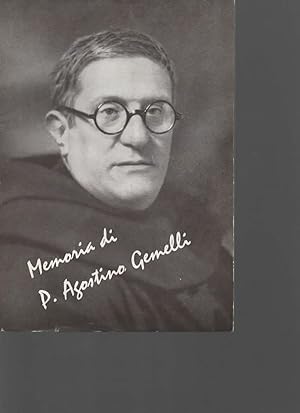
In his report on the 1920 visit, Gemelli wrote that "Padre Pio has all the somatic characteristics of hysterics and psychopaths (...). Therefore, the wounds on his body are false (...) the result of a morbid pathological action." He gave only one detail: he was unable to see the friar's wounds, who, in the absence of a written order from the competent authority, had opposed the investigation. But by then the mud machine was in motion, the gears of the system of corruption and complicity that linked San Giovanni Rotondo to Rome had begun to work at full speed, greased by a very long habit. The rumours, suspicions, calumnies and defamations of the poor saint became increasingly intense and severe, so that on May 31, 1923, the first docuмent of censure of the Holy Office was published. More followed during an ordeal that lasted ten years.
THE FIRST INVESTIGATIONS OF A STOWAWAY
As a result of these events, in 1925 Brunatto was expelled from the convent where he had lived for five years and decided to defend his spiritual father. He gathered evidence and testimonies about the young friar's candor and the spiritual good that flowed from him. But above all, he discovered who the accusers of the friar imprisoned in San Giovanni Rotondo really were and what they were hiding. With two bags full of docuмents, he headed to Rome convinced that justice would soon be done to the righteous man.
He did not yet know that the clerical mafia, hostile to the purity of Padre Pio, had already successfully conspired in 1919, during the reign of Benedict XV, who was not hostile to the stigmatized Capuchin. Now, under the name of Pius XI, Cardinal Achille Ratti had become Pope, who had no benevolence for the poor friar, and the situation had become even more serious. On July 3, 1922, the new pontiff had received the Archbishop of Manfredonia in a private audience and had willingly initiated the first restrictive measures regarding the spiritual and pastoral work of the stigmatized friar.
In the congregation opposed to the friar of San Giovanni Rotondo, around Pius XI there were, to mention only the most influential elements, almost the entire Holy Office, Cardinal Gaetano De Lai, Cardinal Carlo Perosi, Cardinal Donato Raffaele Sbarretti Tazza, Cardinal Luigi Sincero, the Prefect of the Sacred Apostolic Palaces Monsignor Ricardo de Samper, the Master of the Chamber of His Holiness Monsignor Camillo Caccia Dominioni, l'Osservatore Romano and, of course, Father Agostino Gemelli, a great friend of the Pontiff. Only the Secretary of State, Cardinal Pietro Gasparri, and the Secretary of the Holy Office, Cardinal Rafael Merry del Val, gave credit to Padre Pio. In the middle, oscillating from one side to the other depending on the interests of the moment, were the Jesuits Father Enrico Rosa, director of the Civiltà cattolica, who was highly regarded by the pontiff, and Father Pietro Tacchi Venturi, who was highly regarded by the head of government, Benito Mussolini.
In Rome, Brunatto was able to count on the help of Don Luigi Orione, who knew the curia well and directed him to Cardinals Gasparri and Merry del Val. Although so different and certainly not friends, the two prelates perhaps understood the meaning of Padre Pio's mission. In any case, they understood that the friar's fate was linked to the war that both had undertaken in the desperate enterprise of clearing the Leonine walls.
There were no immediate results, so "the stowaway" decided to force the hand by publishing his first book, Padre Pio of Pietrelcina . The volume was immediately placed on the index of the Holy Office, of which Merry del Val was secretary, but Pius XI was the Prefect, in that case not only nominally.
However, a first positive effect of the publication was revealed shortly afterwards because an Apostolic Visitor, Monsignor Felice Bevilacqua, was sent to San Giovanni Rotondo, who chose Emanuele Brunatto as his lay coadjutor.
The results of the investigation are summarized below in the White Paper, which omits the most scandalous content of the minutes: " The apostolic visitation collected evidence of simony, blackmail, sacrilege and the continuous sɛҳuąƖ relations of the canon (Palladino) with quite a few women. Informed of the investigation, he threatened one of them with "cutting her throat in the street" if she denounced him. Palladino had led this scandalous life for six years under the eyes of the archpriest, without any sanction or reproach. The canon kept him under threat: "Let Prencipe (the archpriest) mind his business, because I have more in my hand than it takes to ruin him." In fact, the Visitor had to accuse the archpriest of several charges of simony, forgery and use of forgery, slander, continuous sɛҳuąƖ relations with two women in the area, etc. (…) As regards the As regards the Archbishop of Manfredonia, Pasquale Gagliardi, the Apostolic Visitation had to establish the truth about the illegal acts that are painful for us to mention: rape of a cloistered nun, continuous sɛҳuąƖ relations with another nun, priesthood agreed upon in exchange for payment to known reverses, habitual simonies, appropriation of Mass offerings in thousands of cases, etc.
Following the apostolic visitation, Palladino was suspended a divinis, Archpriest Prencipe and Canon De Nittis were accused of immorality and false testimony, and Archbishop Gagliardi was removed from office.
But, according to a custom that never goes out of fashion, they soon returned to the scene, cleansed of their honour and protected in their actions by the eminent Roman guards. And Padre Pio continued to be persecuted with more canonical restrictions fuelled by the cleverly aroused calumny.
HIGH-PRICED RESEARCH. Emanuele Brunatto was able to uncover the vermin who was the source of the persecution of his spiritual father thanks to a confidential task entrusted to him by Monsignor Bevilacqua on behalf of Cardinal Gasparri. On December 15, 1927, Monsignor Bevilacqua received a short letter on the letterhead of His Holiness's Secretary of State: " The undersigned Cardinal Secretary of State, with the special approval of the Holy Father, entrusts to Monsignor Felice Bevilacqua the task of carrying out an investigation into an ecclesiastic, the details of which are to be made known orally, authorizing him to examine persons whom he considers useful for the purposes of the investigation and to subject them to the oath “de veritate dicenda et de secreto Servando”; and to this end granting him all necessary and appropriate faculties, ordering any person, even those constituted with dignity or, in any case, exempt, to lend themselves to whatever he requests. Pietro Cardinal Gasparri ."
Four days later, on December 19, Bevilacqua wrote to Brunatto on a letterhead of the Vicariate of Rome - oficio II: " Since by mandate of the Higher Authority I am required to canonically investigate the conduct of an ecclesiastic, I hereby instruct Mr. EMANUELE BRUNATTO to carry out some investigations into the matter. Mons. Felice Bevilacqua ."
The White Book does not go into the details of the investigation. The Letter to the Church , printed in 1929, and The Antichrists in the Church of Christ , printed in 1933, now almost unavailable, came in its place. And there is also Il Santo e il Peccatore , published in 2013 by Edoardo Misuraca. A careful comparison shows that the three volumes, in the narrative part, are substantially superimposable and there is a reason. The Letter to the Church was written to threaten publication and obtain in return the release of Padre Pio: but, once the entire circulation had been handed over to the Apostolic Nunciature in Munich, the Vatican authorities did not keep their promise.
The Antichrists in the Church of Christ , written for the same purpose, had the desired effect and was therefore withdrawn from circulation. The Saint and the Sinner , which is not easy to find, aims to fill the historiographical gap due to the strategic management of the previous books, and is therefore a kind of rewriting. Misuraca, Brunatto's nephew, thus allows us to understand who was the man who saved the recluse friar of San Giovanni Rotondo and what he really did. " I did it to keep a promise made at the tomb of Emanuel 20 years ago," he says. "And also to protect by means of copyright the news and facts it contains and which are endorsed by the enormous quantity of docuмents and photographs in the exclusive possession of the association of which I am a member together with my friend Alberindo Grimani . ”
The following quotes have been taken from this latest edition of the story. With the knowledge that names, facts and circuмstances make the hand tremble, it is appropriate, however, to recount at least a very small part of what emerged from the investigation led by His Holiness's Secretary of State, disregarded by His Holiness and conducted by "the policeman." Those who prefer to remain in the dark can go directly to the final chapter. And the old-fashioned father who wonders whether it is worth saying "certain things" should ask himself whether it is honest to blow on the fire of Bergoglio's scandals and cover up those of his predecessors.
THERE IS ROT IN ROME, AND IT IS NOT FROM TODAY
"It was not a question of (....) pursuing one or another paedophile, but of dismantling a system of perversion that had been inserted into the upper echelons of the Church. (...) Around this congregation of inverts competing for the favours of the Holy Father, another mafia of Jesuits and prelates was far from fighting the scandal, and used it only for personal ends, in order to put the miseries of the Pope to personal advantage." Perhaps a little harsh, of the harshness of the Roman Catholic who discovers the power of sin where he has been taught that it cannot be, this description by Brunatto immediately makes one understand who and what dominated the earthly destiny of Padre Pio.
The pontificate in question is that of Benedict XV, but, in order not to get lost, it is necessary to follow the thread of the investigation of the "Policeman", which starts at the court of Pius XI. Two of the first people brought to the attention of the researcher were Monsignor Ricardo Sanz de Samper y Campuzano, Prefect of the Sacred Apostolic Palaces and private butler of His Holiness, and Monsignor Camillo Caccia Dominioni, Master of the Chamber of His Holiness. Both were so close to the throne and the papal power thanks to Benedict XV, that they smelled like cardinals, but Gasparri and Merry del Val wanted to avoid their designation knowing that both were unworthy of it.
Ricardo Sanz de Samper and Campuzano
In his memoirs, Brunatto sums up the situation with frankness and a taste for the palate: " The historical manifestation of this dramatic reality under the pontificate of Pius XI is illustrated by the photograph that frames his throne during the ceremonies: to the right of the Pope is Monsignor Ricardo de Samper, to his left Monsignor Camillo Caccia Dominioni, (...). One and the other notoriously inverted. This unprecedented scandal had lasted six years and seemed to have no remedy. The highest-ranking - de Samper - could not be removed from office without first having been ordained cardinal, and if by chance the Pontiff had wanted to go beyond tradition and remove him without the cardinal's hat, he was able to demonstrate that Caccia Dominioni was certainly no better than him and that, on the other hand, the Pontiff himself was linked to his Master of the Chamber by an old and particular friendship... In any case, whatever way you want to understand it, Pius XI owed Caccia Dominioni a great debt to him. his previous appointment as cardinal and, therefore, his promotion to the papacy."
If Caccia Dominioni's conduct was more discreet and shrewd, de Samper's was public knowledge. When Benedict XV had previously expressed the idea of appointing him Prefect of the Sacred Apostolic Palaces, Cardinal Merry del Val, who had been his fiercest opponent in the conclave, had thrown himself at the feet of the Pope, begging him to avoid such a great scandal and to prevent the Church from suffering such shame.
Brunatto docuмented Samper's participation in sodomite orgies in the company of his cousin Monsignor Peri-Morosini, later suspended a divinis for habitual pederasty. He also discovered the complicity of Cardinal Luigi Sincero. " I also obtained the confession of six seminarians who had participated - two at a time - in De Samper's sodomite orgies, every day and for several months, in his Vatican apartment, and I collected the testimonies of the (...) domestic - who was induced to commit acts whose obscene character surpasses the imagination ." I will spare the reader the testimony. Witnesses and evidence were also found about the conduct of Monsignor Caccia Dominioni. The young man who had spoken of it, who was fifteen years old at the time of the events, unleashed a scandal which, between May and August 1928, caused such an uproar in Rome that " Pius XI was then forced to withdraw - for a time - Monsignor Caccia Dominioni from his court. He sent him to the Eucharistic Congress in Sydney, Australia, to bring you the papal gift of a solid gold chalice: the chalice of the Divine Sacrifice! For a few more years, the cardinalate of the Master of the Chamber was to be discarded, as you can well imagine ...".
In fact, Caccia Dominioni, from Pius XI and throughout the hierarchy, had very powerful protections. Father Rosa, director of the Civiltà Cattolica , intervened on his behalf, a selective moralist, who only pursued scandalous behavior when it was useful to the Jesuit cause.
Monsignor Bevilacqua, who had also entrusted the investigation to Brunatto, asked the investigator to tone down and even distort his account. The usual mudslinging machine was set in motion to discredit the inquisitor and exonerate the person under investigation. And if De Samper was forced to leave his post without the cardinal's hat, Caccia Dominioni, on the other hand, had it.
It was he, as Cardinal Protodeacon of the Holy Roman Church, who announced the election of Pius XII on March 2 and then crowned him in the ceremony of March 12. Almost as if to say to those who know how to understand that, even more than Sicily, the land of the leopard where everything changes so that nothing changes, it is that territorial island that is beyond the Tiber, and is not a portion of Heaven on earth.
BENEDICT AMONG THE SPIES
Once the right thread was seized, the investigation of Padre Pio's "stowaway" began to unravel an infernal skein placed at the heart of more than one pontificate and in which figures of various kinds were entangled, from perverts who mocked faith and morality to unsuspected defenders of doctrinal rigor, reluctant to practice it in themselves. A champion of this breed of scoundrels was " Rudolph Gerlach, who was part of the system with the same title as Caccia Dominioni, de Samper, Diana... from the beginning of the pontificate of Benedict XV ."
An aspiring officer expelled from the German army for having executed a forgery, Gerlach entered the Salesian college in Freiburg in 1907, then moved on to the Capranica in Rome and was ordained a priest. " He served at the papal court as a Secret Waiter Participant. A likeable young man, he was for a time the favourite of Benedict XV ." In addition, Gerlach was a German spy and, while the pontiff condemned the useless slaughter, he contributed to the defeats and massacres of the Italian military. Among other things, in 1916, he was the organiser of the sinking of the battleship Leonardo da Vinci. Once the game was discovered, he managed to save himself thanks to the good offices of the Pope and his entire court. Brunatto writes: " Gerlach, warned, immediately made the most serious threats to the Pontiff and the Secretariat of State negotiated feverishly with the Italian government, obtaining the departure - under suitable escort - of the spy in the cassock towards Switzerland ."
Very interesting, and above all disturbing, is the reconstruction of the defensive apparatus of the spy put in place by the Vatican Curia at the trial that opened on April 12, 1917 before the Military Tribunal of Rome: " Father Massaruti (Jesuit), Cardinal Bisleti, Cardinal Vannutelli, Monsignor Tedeschini (who was the Vatican diplomatic messenger through whom Grlach's private letters were sent), Monsignor Ciccone, the Prefect of the Vatican Library (Monsignor Achille Ratti), Admiral and Marquis Antonio della Chiesa, Commander Hirschbül of the Swiss Guard, Prince Aldobrandini, Count Camillo Pecci, Commander Angelini (director of Osservatore Romano), Marquis Gaetano de Felice (for Corriere d'Italia and Avvenire d'Italia, of which he was editor), the Vatican pharmacist, the honorable Valenzani, Dr. Filiziani (director of Vera Roma).... nobody failed to respond to the call to defend the spy, and, in spite of everything, the Italian Court sentenced Monsignor Gerlach, in absentia at the trial, to life imprisonment. (…) The day after the sentence, Monsignor Gerlach dedicated a photograph to his father in which he showed his recent decorations: Iron Cross, Great Heart of Francis Joseph, Order of Bavaria, Bulgarian Civil Merit, Cross of the Collar of German Castilians, Cross of Ludwig of Bavaria, Order of Kontur of Bavaria, etc...".
Anyone who has doubts about what he has read so far can verify the incontrovertible veracity of the names, facts and circuмstances in the history books and newspapers of the time. Or he can take a look at the docuмentation at its source, discovering even more tremendous truths. Or, again, read the testimony given by Father Carmelo da Sessano for the cause of beatification of Padre Pio, of which he was superior from 1953 to 1959 as guardian of the convent of San Giovanni Rotondo. In the Positio , IV-A1, Father Carmelo says: " When, for the first time, many years ago, I had the good fortune, or rather, the bad luck, to read 'The Antichrists in the Church of Christ', I could not sleep much! There were biographical data of high ecclesiastical figures, supported by docuмents, which said they were... fictionalized. Pages that today would go around the world, if they were published in `Men', `Stop' or `Playboy' !
But perhaps the most convincing proof lies in the fact that, after the 1929 mockery of the Letter to the Church , handed over to the Vatican authorities without Padre Pio being released, in The Antichrists in the Church of Christ, Brunatto showed himself determined to go all the way. Not even an extortion letter from his spiritual father to persuade him to desist convinced him to do so. "The Policeman", or the "Publican" if you prefer, replied that he would not stop: and the persecution of Padre Pio, after ten years, suddenly stopped. Miracle of investigations carried out as God commands.
The poor friar's second Via Crucis began on July 2, 1959, just like the first, with a bishop received in private audience by a pope. This time it was Monsignor Girolamo Bartolomeo Bortignon, Ordinary of Padua, who presented to John XXIII his accusations against the stigmatized friar and the prayer movement linked to his pastoral care. To free Padre Pio, a new investigation would be necessary. A new chapter in the Infernal Novel.
ONLY HOLINESS CAN SAVE US
I wrote these pages trying to imagine all the pain and bewilderment of the man who, at the behest of Providence, revealed the wicked plot behind the gold embroidery displayed for the veneration, if not the adoration, of the faithful of the holy Roman Church. And above all, I tried to capture at least a particle of the pain felt by the man who took upon himself the burden of bearing the alpha and omega of such an infernal design.
In front of my desk, on the book-lined shelves, are pictures of some of the saints I venerate with the most devotion and love. In the center is the Crucifix of St. Benedict, the one I placed in my mother's hands as she lay dying here in my study, where I am now working. Crux Sancti Patris Benedicti, Crux Sacra sit mihi lux, non draco sit mihi dux, vade retro, Satana! Numquam suade mihi vana, sunt mala quae libas, ipse venena bibas.
In the face of this Crucified One and these saints, the time has come to draw some conclusions, or at least some considerations, from what has been narrated. Everything can be summed up in one word: " Butchers! ", that terrifying judgment that Jesus, through the mouth of Padre Pio, pronounced on the priests who called him to be present in the consecrated host and immediately afterwards profaned it. And, one must be honest enough to admit, at that time the so-called new Mass was not yet celebrated. Therefore, the root of the evil is not only in the change of ritual. At the bottom was, and is, what precedes and presides over the profanation of the rite, of any rite, by stealing it in a simple ceremony or by paying it to the Enemy: the will to destroy and invert the priesthood. Nor can it be reduced to a simple, though important, question of doctrine, because many of the men implicated in the interminable scandal, of whom no eminent and venerated names have been revealed, were great defenders of the Charter. Someone might object that personal scandal is attenuated, or even invalidated, by the proclamation of the true faith. An argument whose subspecies sounds like this: "It has always been that way, the one who is scandalized is a moralist." But this is a poor argument for a bar or a college student, because if you do not live as you believe, you end up believing as you live, making doctrine a bargaining chip. It is precisely the fact that it has always been that way and that no one has been scandalized that has led us to the planetary manifestation of an inverted church.
It is not even a simple question of upright morality. If morality is not the practice of true faith, one always ends up preaching one thing while doing another . And the more the evil is witnessed to by the uprightness of the teacher and the pastor, the greater the harm.
Even less can the solution to the drama be reduced to the misunderstood thaumaturgical concept of Tradition, since the Church of Benedict XV and Pius XI, to limit ourselves to the case in question, was identical in its scandals to that of Bergoglio. Too often, those who feed on Tradition end up contenting themselves with a sin that is only a little older than that of their time. Tradition must have the courage to seek it out, finding its source and following its course where it has never dried up.
The only Christian response to evil, the only true and practicable one, is that of Padre Pio: holiness. That man accepted suffering at the hands of the Church just as the first martyrs accepted suffering at the hands of the empire. In both cases, only the renunciation of one's own life for the love of Christ - holiness - stands in opposition to unjust and inverted power.
As close as one can get to the immense mystery of the stigmatized friar, one can imagine that the mission to which he has dedicated himself is to save the priesthood of Christ from those who have the hierarchical power to transmit it and the infernal will to profane it.
In memory of the prophetic warning that their true mission would not begin until after their death, good priests who do not want to be just beautiful cut flowers without roots should kiss the hem of their habit every day, as the poor "Publican" did after having served him Mass.

 Topic: Defaming Padre Pio (Read 51622 times)