You have the definitions from the Council of Trent (
1545-1563)Canons on the Sacraments in General: - (Canon 4):
"If anyone shall say that the sacraments of the New Law are not necessary for salvation, but are superfluous, and that although all are not necessary for every individual, without them or without the desire of them (sine eis aut eorum voto), through faith alone men obtain from God the grace of justification; let him be anathema."
Decree on Justification - (Session 6, Chapter 4):
"In these words a description of the justification of a sinner is given as being a translation from that state in which man is born a child of the first Adam to the state of grace and of the 'adoption of the Sons' (Rom. 8:15) of God through the second Adam, Jesus Christ, our Savior and this translation after the promulgation of the Gospel cannot be effected except through the laver of regeneration or a desire for it, (sine lavacro regenerationis aut eius voto) as it is written: "Unless a man be born again of water and the Holy Spirit, he cannot enter in the kingdom of God" (John 3:5).
That agree with the teaching of Saint Thomas Aquinas (1225-1274) who the Council Fathers held in esteem
"The sacrament of Baptism may be wanting to someone in two ways. First, both in reality and in desire; as is the case with those who neither are baptized, nor wish to be baptized: which clearly indicates contempt of the sacraments, in regard to those who have the use of free-will. Consequently those to whom Baptism is wanting thus, cannot obtain salvation: since neither sacramentally nor mentally are they incorporated in Christ, through Whom alone can salvation be obtained.
Secondly, the sacrament of Baptism may be wanting to anyone in reality but not in desire: for instance, when a man wishes to be baptized, but by some ill-chance he is forestalled by death before receiving Baptism. And such a man can obtain salvation without being actually baptized, on account of his desire for Baptism, which desire is the outcome of faith that worketh by charity, whereby God, Whose power is not tied to visible sacraments, sanctifies man inwardly. Hence Ambrose says of Valentinian, who died while yet a catechumen: I lost him whom I was to regenerate: but he did not lose the grace he prayed for."
And the same teaching from Saint Alphonsus Liguori (1691-1787) which specifically mentions the Council of Trent and John 3:5
But baptism of desire is perfect conversion to God by contrition or love of God above all things accompanied by an explicit or implicit desire for true Baptism of water, the place of which it takes as to the remission of guilt, but not as to the impression of the [baptismal] character or as to the removal of all debt of punishment. It is called 'of wind' ['flaminis'] because it takes place by the impulse of the Holy Ghost Who is called a wind ['flamen']. Now it is de fide that men are also saved by Baptism of desire, by virtue of the Canon 'Apostolicam De Presbytero Non Baptizato' and the Council of Trent, Session 6, Chapter 4, where it is said that no one can be saved 'without the laver of regeneration or the desire for it.'
With the same truth held in Canon Law (1917)
CAN. 737.
§ 1. Baptismus, Sacramentorum ianua ac fundamentum, omnibus in re vel saltem in voto necessarius ad salutem, valide non confertur, nisi per ablutionem aquae verae et naturalis cuм praescripta verborum forma.
§ 2. cuм ministratur servatis omnibus ritibus et caeremoniis quae in ritualibus libris praecipiuntur, appellatur sollemnis; secus, non sollemnis seu privutus.
"Baptism is called the gate to, and the foundation of, the other Sacraments, because without it no other Sacrament can be validly received. The Church has ever taught that Baptism is absolutely necessary for salvation, - either really or by desire - and that consequently no other sacrament can be validly received without it. Thus ordination would be invalid and imprint no indelible character if the ordinandus had not been baptized. This necessity of Baptism is called necessitas medii, necessity of means, because without it salvation cannot be obtained. The reason for this absolute necessity lies in the words of Our Lord, John III, 5. Either in re or in voto signifies that the baptismus fluminis or flaminis or sanguinis is sufficient."
And the common consent of Catholic theologians being "theologically certain" as either Catholic doctrine or de fide (of the faith)
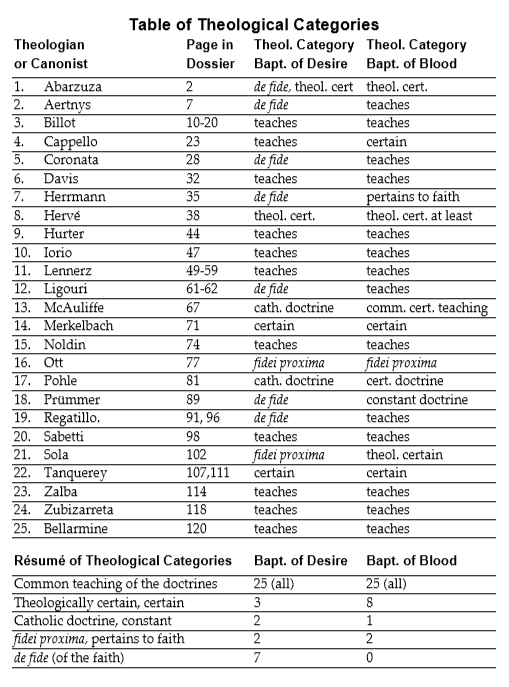
So there is no doubt whatsoever in my mind that Baptism of Desire and of Blood are truths of the Catholic Church that can not be denied.

 Topic: Genuinely curious - rejection of Baptism and the Council of Trent (Read 23324 times)